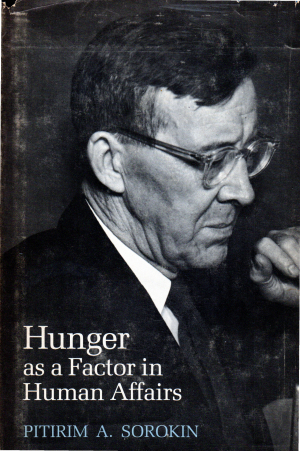
from Sorokin’s foreword to the 1967 edition of The Sociology of Revolution:
… one emendation needs to be made in my theory of revolution as outlined in this book. It stresses the “behavioristic” and biopsychological too much and does not sufficiently take into account the sociological. It overestimates the role of hereditary factors and unconditioned reflexes and underestimates somewhat the role of the acquired, sociocultural forces in the engenderment, development, suppression, and life course of revolutions; but the relationship between the unconditioned and acquired actions-reactions of individuals and groups in revolutions remains essentially the same as outlined in this study.
This volume does not analyse the course of revolutions beyond their second restraining phase. If it had, it would have shown that while some societies could not stand the fiery ordeal of a great revolution and have temporarily or forever lost their identity, unity, and independence, other societies have successfully overcome this danger and have established a new, post-revolutionary sociocultural order, system of values, and a nobler, better, more creative way of life. The Russian Revolution exemplifies this last course. The Soviet peoples have passed beyond the second phase of their revolution and are now building their post-revolutionary society, culture, and way of life. [italics added]
I agree with Sorokin’s comments on the overemphasis, in the first edition, on behaviorism. These sections of the book seem somewhat dated, tedious, and at times to have a pseudoscientific feel.
Re the comments about the Soviet peoples having “passed beyond the second phase of their revolution” and building a “post-revolutionary society, culture, and way of life”: this reflects the evolution of Sorokin’s .views about the Russian revolution and the USSR. See
Yuri Doykov, “Pochemu molchal Pitirim Sorokin?; Ot Lubyanki do Garvarda (1918-1930)” [Why was he silent?; Pitirim Sorokin? From the Lubyanka to Harvard (1918-1930)]
Foreword, ‘The Sociology of Revolution’
— posted by Roger W. Smith
August 2024

 Pitirim Alexandrovich Sorokin