Binder1
The following is the text of a New Yorker article based on an interview conducted with Sorokin:
“Longevity Recipe”
“The Talk of the Town”
The New Yorker
January 4, 1958
pp. 16-17
Longevity Recipe
Are kind, permissive, lurk-around-the house parents, so much de rigueur nowadays, all they’re cracked up to be, psychologically and pedagogically speaking? Does an absentee or punitive father spell future failure for his little ones? Do people learn by suffering or so they go to pieces? Such questions have furrowed our brow during several decades of buttonholing famous men, many of whom, it turned out, had been either quickly orphaned or personally abandoned or paternally cuffed. This ponderous line of thought possessed us anew the other morning when we sat down at a table in the West Fifty-first Street Schrafft’s for a prearranged chat with Professor A. Sorokin, director of the Harvard Research Center in Creative Altruism and author of thirty books, among them “Time-Budgets of Human Behavior,” “The American Sex Revolution,” and “Social and Cultural Dynamics.” A merry scholar of sixty-eight if we ever saw one, his face set in quizzically humorous lines, his work translated into fifteen tongues; happy married, by his own account, for forty years to a prominent biologist, and the father of two promising sons, one a physicist and the other a student at Harvard Medical School; a vigorous fisherman, mountain climber, camper-out, and tiller of a big do-it-yourself garden of azaleas, rhododendrons, lilacs, and roses in Winchester, Massachusetts, Professor Sorokin is also the possessor of an upper lip that seems somewhat smashed in. We would never have mentioned this if the Professor had not brought it up himself. “Father did it with a hammer when I was nine,” he said. “He was a good man, but he used to hit the bottle, and then he’d hit my brother and me. Our mother died when I was four. I was born in Touria, a village in Vologda Region, near Archangel. It was a barren rural, extremely cold section. I am from the very bottom of Russian society. Mother was the daughter of poor peasants and Father was an itinerant artisan who did painting, silvering, and gilding, in churches and peasants’ houses. After Mother’s death, my older brother and I–a younger brother was adopted by an aunt–moved with Father from village to village, helping him with his work. We separated from him after the hammer incident, and he died a year later. We continued our nomadic life, gilding icons, and so forth, until in one hamlet, Gam, I came across a newly founded school. I took an examination, was given a scholarship, graduated after three years, and won another three-year scholarship, at the Teachers College in Kostroma Region.”
Professor Sorokin paused to polish off some ham and eggs. “In 1906, when I was seventeen,” he said, “I was arrested there by the Czarist police and imprisoned for four months for giving revolutionary talks at factories. I was later arrested twice more by the Czarist police and three times by the Bolsheviks. Being arrested under the Czar was rather cozy. Czarist prisons were first-class hotels. The wardens were our office boys. ‘Telephone your friends from my office,’ they would say. “Help yourself to the books there.’ Bolshevik arrests were very different. Every day was a day of jeopardy. After Teachers College I went to night school in St. Petersburg, and then spent several years studying, and subsequently teaching, at the Psycho-Neurological Institute and the University of St. Petersburg. I gave courses in criminology and penology. In 1917, I was one of four founders of the All-Russian Peasant Soviet and a member of its executive committee, and I became secretary to Kerensky, then Prime Minister. I was also editor-in-chief of Volia Naroda, the Petrograd newspaper that was the main voice of the Kerensky government. My first Bolshevik arrest, for opposing such Communist leaders as Lenin, Trotsky, and Kamenev, was in January 1918. My second, in the fall of that year, was for helping engineer the overthrow of Communist government in Archangel. I was condemned to death, was released after six weeks through the intercession of a former student of mine, and returned to the university, where I founded its Department of Sociology. I wrote five books on sociology and on law, and underwent my final arrest. I was then comfortably banished, and went to Czechoslovakia on the invitation of my good friend President Masaryk, and in 1923 I came here to lecture at the Universities of Wisconsin and Illinois. I joined the University of Minnesota faculty in 1924, and in 1930 I went to Harvard, where I organized, and became chairman of, the Department of Sociology. In 1948, I founded the Research Center in Creative Altruism there, with the financial support of Eli Lilly, an altruistic Indianapolis pharmaceutist. So far, Mr. Lilly and a fund called the Lilly Endowment have given us a hundred and thirty-five thousand dollars between them to conduct studies on how to make human beings less selfish and more creative. I haven’t been arrested since 1922, but I have revied a few parking tickets. I rather miss being arrested.”
This nostalgic multiple jailbird passed us the sugar, and we pressed him for a further word on creative altruism. “In brief, as a result of my studies, beginning in the nineteen-forties,” he said, “I came to the conclusion that if individual human beings, groups, and cultural institutions in general did not become notably more creatively altruistic, nothing could save mankind. Popular prescriptions, such as political changes, religious changes, and education as a panacea against war, won’t do it. This century, in which science and education have reached unrivalled heights, is the bloodiest of all the twenty-five centuries of Greco-Roman and European history. Have you read my ‘Altruistic Love’? It deals with some of the ascertainable characteristics of five hundred living American altruists and forty-six hundred Christian saints. The extraordinary longevity and vigorous health of the saints is remarkable! Or my ‘The Ways and Powers of Love’? It uncovers a sufficient body of evidence to show that unselfish, creative love can stop aggressive inter-individual and inter-group attacks, tangibly influence international policy, and pacify international conflicts, and that altruistic persons live longer than egoistic individuals. Or my ‘Man and Society in Calamity’? In this, I confirm the law of polarization, which runs contrary to the Freudian claim that calamity and frustration uniformly generate aggression, and contrary to the old claim, reiterated recently by Toynbee, that they lead uniformly to the moral and spiritual ennoblement of human beings. What the law of polarization holds is that, depending upon the type of personality, frustrations and misfortunes may be reacted to and overcome by positive polarization, resulting either in an increased creative effort (consider the deafness of Beethoven, the blindness of Milton) or in altruistic transformation (consider St. Francis of Assisi and Ignatius Loyola), or they may induce negative polarization, in the shape of suicide, mental disorder, brutalization, increase of selfishness, dumb submissiveness, or cynical sensualism. This works both individually and collectively.”
We unfurrowed our brow and left, resolved to love one and all, and to live to be a hundred and three.
— posted by Roger W. Smith
October 2020
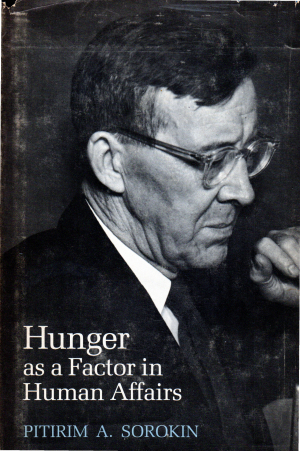
 Pitirim Alexandrovich Sorokin