— posted by Roger W. Smith
November 2024
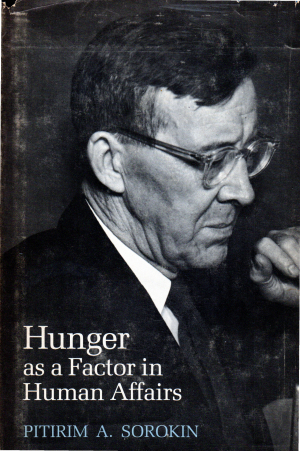
from Sorokin’s foreword to the 1967 edition of The Sociology of Revolution:
… one emendation needs to be made in my theory of revolution as outlined in this book. It stresses the “behavioristic” and biopsychological too much and does not sufficiently take into account the sociological. It overestimates the role of hereditary factors and unconditioned reflexes and underestimates somewhat the role of the acquired, sociocultural forces in the engenderment, development, suppression, and life course of revolutions; but the relationship between the unconditioned and acquired actions-reactions of individuals and groups in revolutions remains essentially the same as outlined in this study.
This volume does not analyse the course of revolutions beyond their second restraining phase. If it had, it would have shown that while some societies could not stand the fiery ordeal of a great revolution and have temporarily or forever lost their identity, unity, and independence, other societies have successfully overcome this danger and have established a new, post-revolutionary sociocultural order, system of values, and a nobler, better, more creative way of life. The Russian Revolution exemplifies this last course. The Soviet peoples have passed beyond the second phase of their revolution and are now building their post-revolutionary society, culture, and way of life. [italics added]
I agree with Sorokin’s comments on the overemphasis, in the first edition, on behaviorism. These sections of the book seem somewhat dated, tedious, and at times to have a pseudoscientific feel.
Re the comments about the Soviet peoples having “passed beyond the second phase of their revolution” and building a “post-revolutionary society, culture, and way of life”: this reflects the evolution of Sorokin’s .views about the Russian revolution and the USSR. See
Yuri Doykov, “Pochemu molchal Pitirim Sorokin?; Ot Lubyanki do Garvarda (1918-1930)” [Why was he silent?; Pitirim Sorokin? From the Lubyanka to Harvard (1918-1930)]
Foreword, ‘The Sociology of Revolution’
— posted by Roger W. Smith
August 2024
Sorokin, ‘Illusions and Self-Deceptions of Modern Man’
Posted here is the following:
Pitirim A . Sorokin
“Illusions and Self-Deceptions of Modern Man”
IN
Sociology of Knowledge, edited by : Kewal Motwani (Bombay: Somaiya Publications, 1976)
— Roger W. Smith
November 2022
Наука и жизнь (Science and Life). a Russian émigré magazine, was published in New York from March 1923 to July 1924.
I have copied all the issues from a microfilm at the New York Public Library. See PDF attached here.
An article by Sorokin appeared in the December 1923 issue (see attached).
— posted by Roger W. Smith
November 1923


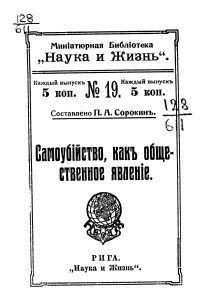
П.А. Сорокин САМОУБИЙСТВО, КАК ОБЩЕСТВЕННОЕ ЯВЛЕНИЕ, Рига 1913
P. A. Sorokin, Suicide as a Societal Problem. Riga 1913
— posted by Roger W. Smith
August 2022
Posted here (PDF file above) is the following article by Sorokin:
Some of the Basic Factors in the Improvement of Scholarship among American Students of the Social Sciences
By Pitirim A. Sorokin
Social Science, Vol. 11, No. 2 (April 1936), pp. 93-99
It is a very interesting article in terms of Sorokin’s views not only on the teaching of sociology, but his views on sociology and sociological scholarship.
— posted by Roger W. Smith
April 2022
Before the first world war and the later catastrophes of our time, science largely shunned this field [altruistic love]. The phenomena of altruistic love were thought to belong to religion and ethics, rather to science. They were considered good topics for preaching, but not for research and teaching. Moreover, prewar science was much more interested in the study of criminals than of saints, of the insane than of the genius, of the struggle for existence than of mutual aid, and of hate and selfishness than of compassion and love.
The explosion of the gigantic disasters after 1914 and the changing danger of a new suicidal war have now radically changed the situation. These calamities have given impetus to the scientific study of unselfish love. …
… without reinforcement by the energy of unselfish love, all the fashionable prescriptions for the elimination of those ills of humanity cannot achieve their task. This conclusion equally applies to all the prescriptions that try to prevent conflicts by either purely political, educational, sham religious, economic, or military means.
For instance, we may like to think that if tomorrow all the governments of the world were to become democratic, we would finally have a lasting peace and crimeless social order. Yet recent careful studies of comparative criminality of 967 wars and 1,629 revolutions in the history of Greece, Rome, and the Western countries … up to the present time show that democracies have hardly reversed belligerent, turbulent, and crime-infested nanotocracies. The same goes for education in its present form, other panaceas against international wars, civil strifes, and crimes.
Since the tenth century … education has made enormous strides forward. … Yet the number and deadliness of wars, bloody revolutions, and grave crimes have not decreased at all. On the contrary, in this most scientific and most educated twentieth century, they have reached unrivaled heights and have made this century the bloodiest in the past twenty-five centuries of Graeco-Roman and Western history.
Similarly, the tremendous progress of knowledge and the domestication of all of all forms of physical energy has not given man any lasting peace. Rather, it has greatly increased his chances of being destroyed in all forms of interhuman conflicts.
— Pitirim A. Sorokin, “The Mysterious Energy of Love”; a lecture by Sorokin given in 1959 at an undisclosed university.
*****************************************************
… none of the prevalent prescriptions against international and civil wars and other forms of interhuman bloody strife can eliminate or notably decrease these conflicts.
By these popular prescriptions I mean, first, elimination of wars and strife by political changes, especially by democratic political transformations. Tomorrow the whole world could become democratic and yet wars and bloody strife would not be eliminated because democracies happen to be no less belligerent and strife-infected than autocracies. Still less pacification can be expected from autocracies. Neither the United Nations nor a world government can give a lasting internal and international peace if the establishment of these bodies is not reinforced by notable altruization of persons, groups, institutions, and culture.
The same goes for education in its present form as a panacea against war and bloody strife. Tomorrow all grown-up persons in the world could become Ph.D.’s, and yet this enormous progress in education would not eliminate wars and bloody conflicts. Since the tenth century on up to the present, education has made enormous progress. The number of schools of all kinds, the percentage of literacy, the number of scientific discoveries and inventions have greatly and almost systematically increased, and yet the international wars, the bloody revolutions, and the grave forms of crime have not decreased at all. On the contrary, in the most scientific and most educated twentieth century, they have reached an unrivaled height and made this one the bloodiest of all the twenty five centuries of Graeco-Roman and European history.
The same goes for religious changes, if by religion is meant a purely ideological belief in God or in the credo of any of the great religions. One of the evidences for that is given by our investigation of 73 Boston converts “brought to Jesus” by two popular evangelical preachers. Of these 73 converts only one changed his overt behavior in an altruistic direction after his conversion. Thirty-seven converts slightly changed their speech reactions; after their conversion they began to repeat more frequently the words. “Our Lord Jesus Christ” and similar utterances, but their overt behavior did not change tangibly. The remaining converts changed neither their actions nor their speech reactions. If by religious revival and “moral rearmament” is meant this sort of ideological and speech-reactional transformation, it will not bring peace nor decrease interhuman strife, because it represents mainly a cheap self-gratification for psychoneurotics and sham-religious persons.
The same goes for communist, socialist, or capitalist economic remedies, and for scientific, artistic, legal, or other ways of establishing and maintaining lasting peace in the human universe, when these are not backed by increased altruization of persons and groups. In my Reconstruction of Humanity (1948), I have given the minimum of evidence to substantiate these statements. This assumption positively signifies that without a notable increase of unselfish, creative love (as ideally formulated in the Sermon on the Mount) in overt behavior, in overt inter-individual and intergroup relationships, in social institutions and culture, there is no chance for a lasting peace and for interhuman harmony, internal or external. This, then, was our first assumption, already vindicated to a considerable degree by the existing body of inductive evidence. …
While many modern sociologists and psychologists view the phenomena of hatred, crime, and mental disorders as the legitimate objects of scientific study they quite illogically stigmatize as theological preaching or non-scientific metaphysics any investigation of the phenomena of love, friendship, heroic deeds and creative genius. There is no need to argue the patently unscientific nature of such an attitude. It is but one of the manifestations of the prevalent concentration on the negative, pathological, and subhuman phenomena which is typical for the disintegrating phase of our sensate culture.
— Pitirim A. Sorokin, “The Scientific Search for Love,” Fellowship, April 1956
— posted by Roger W. Smith
February 2022
*****************************************************
See also my post
a recorded Sorokin lecture
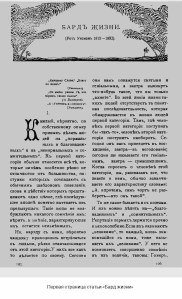
Sorokin, ‘Walt Whitman’ 8th MODIFICATION
Posted here (English and Russian texts above; also PDF of original text):
Pitirim A. Sorokin, “The Bard of Life (Walt Whitman 1819-1892)
Vseobshchiy Zhurnal [Universal Magazine] 2 (1912), 105-119
translated from the Russian by Roger W. Smith
here is the PDF of the same article, again (a clearer image), from:
Pitirim Sorokin, Ranniye Sochineniya 1910–1914 Gody (Pitirim Sorokin, Early Works 1910–1914), St. Petersburg: Pitirim A, Sorokin Foundation, 1914
— posted by Roger W. Smith
February 2022; updated February 2024
Sorokin, ‘Changes in Russia’s Intelligentsia’ – NY Evening Post 12-18-1923
Posted here, above, is my transcription of the following article:
Changes in Russia’s Intelligentsia
Former Idealistic Views Concerning Russian People Profoundly Modified by Revolution
By Pitirim Sorokin
(Translated, with some condensation, by David A. Modell from the Dni,* Russian-language daily in Berlin.)
New York Evening Post
December 18, 1923
pg. 8
–– posted by Roger W. Smith
August 2021
 Pitirim Alexandrovich Sorokin