Posted here (Word document above):
“The hills and the cliffs around the house inspired me: The Sorokins on Cliff Street”
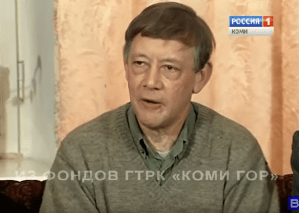
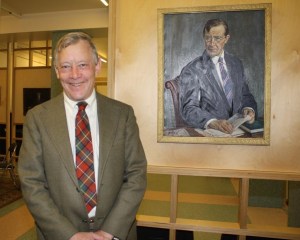
presenter: Roger W. Smith
Winchester Historical Society, Winchester, MA
November 13, 2024
Posted here (Word document above):
“The hills and the cliffs around the house inspired me: The Sorokins on Cliff Street”
presenter: Roger W. Smith
Winchester Historical Society, Winchester, MA
November 13, 2024
These lectures were delivered by Sorokin’s wife Helen (Baratynsky) Sorokin when Sorokin was teaching at the University of Minnesota. His wife Helen (aka Elena) was a graduate student in Botany there.
“Farmers Hold Russ Fate, Women Told,” The Minneapolis Journal, December 29, 1925
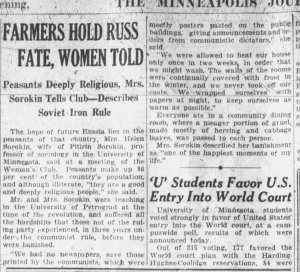
Helen Sorokin lecture – Minneapolis Journal 12-9-1925
“Exile Visons Key to Russ Salvation in Peasant Hands,” Minneapolis Star Tribune, December 29, 1925

Helen Sorokin lecture – Star Tribune 12-9-1925
— posted by Roger W. Smith
October 2024
President’s Report – U of Minnesota, 1924-1925
‘Research in Progress’ – U of Minnesota, 1924-1925
Sorokin taught at the University of Minnesota from 1924 to 1929. Posted here are:
President’s Report, University of Minnesota 1924-1925
Research in Progress, University of Minnesota. 1924-1925
detailing the writings and research activities of Sorokin, his collaborator Carle C. Zimmerman, and Sorokin’s wife, Helen Sorokin.
— posted by Roger W. Smith
August 2024
Most of these have already been posted by me elsewhere.
— Roger W. Smith
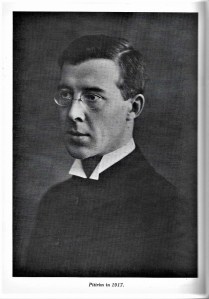


On May 24, 2017, on a trip to Massachusetts, I made a stop in Winchester (a town near Cambridge), where Pitirim A. Sorokin, his wife Elena, and their sons lived. Both of Sorokin’s sons graduated from Winchester High School.
I know the area well, having grown up in Cambridge. My father grew up in nearby Arlington. A musician and piano teacher, he had many piano students in Winchester and was involved in musical productions there.
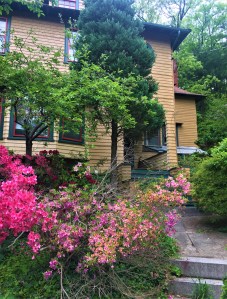
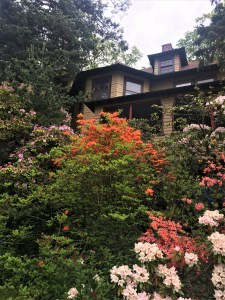
Sorokin and family resided at 8 Cliff Street in Winchester.
I was interested not only to see the residence of a world renowned scholar and writer, but also to see the house because it was famous for its grounds: a garden developed and maintained by Sorokin himself, for which he had won awards from horticultural societies and of which he was proud.
I drove up the block, which was on a steep ascent, using GPS to guide me. The GPS system advised me that I had arrived at my destination, 8 Cliff Street, on my left. I saw 6 Cliff Street, but where was number 8? Number 8 was shrouded and hidden by a profusion of flowering bushes. It reminded me of the Forest of Thorns in “Sleeping Beauty.”
‘Winchester Hillside Aglow with Azaleas’ – Boston Globe 5-23-1954
— posted by Roger W. Smith
February 2024
*****************************************************
Pitirim A. Sorokin residence, 8 Cliff St., Winchester, MA. Photographs by Roger W. Smith
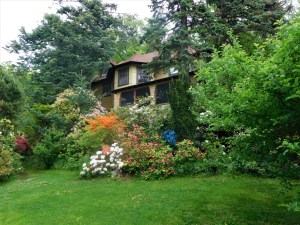

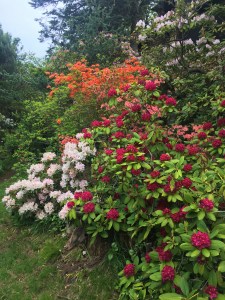
The following letter (in Russian) to the American sociologist Edward A. Ross of the University of Wisconsin was written by Sorokin in July 1922, when Sorokin was in St Petersburg..
ГЛУБОКОУВАЖАЕМЫЙ КОЛЛЕГА!
Позволю себе послать Вам мою небольшую заметку* о Вашей прекрасной книге, случайно попавшей в Петроград, любезно предоставленной мне для прочтения глубокоу-важаемым г. Кини, представителем Христианского Союза молодых людей.
Вместе с этим позволю обратиться к Вам и через Вас другим американским социологам с большой просьбой: мы, русские социологи, до сих пор оторваны от амери-канской и европейской социологии, – книг и журналов. Этот духовный голод чувствуется нами острее, чем мате-риальный. Я лично, выпустивший за эти годы два тома «Системы социологии» (многотомная работа) и «Голод как фактор», не имею литературы зарубежной, вышед-шей после 1916/17 гг. (кроме немногих книг, в частности книг профессора Е. С. Hayes ‘а, любезно им присланных недавно).
Этим Вы очень обрадуете нас и принесете большую пользу. Лично я, как проводник американской социологии в России (и вообще чрезвычайно высоко ставящий Аме-риканское общество), был бы чрезвычайно признателен Вам.
Если правительство России даст мне разрешение – то я намерен через месяца два-три прибыть в Америку и пробыть в ней год или два, чтобы хорошо изучить американскую социологию, многому научиться, а с другой стороны – поделиться и с вами знаниями и, в частности, большим опытом и выводами, полученными из нашего великого трагического эксперимента.
Если Вы позволите – я очень бы желал посетить Вас и поучиться у Вас.
в заключение в позвольте еще обеспокоить Вас одной просьбой. Вам, конечно, известно, что революция сде-лала и ученых бедными. Я еду в Америку без субсидий государства, рассчитывая только на свой мозг и мускулы. Для существования я должен буду искать какой-нибудь работы. Не были бы добры как-нибудь помочь мне в этом отношении? Я готов делать какую угодно работу, не исключая и мускульной, лишь бы она была мне по силам и не была морально унизительной. Я молод (еще 32 года) и жена – преподавательница ботаники в Агрономическом институте (26 лет), и потому мы можем – если не найдется интеллектуальной работы – работать физически.
Вы очень обязали бы нас, если бы помогли нам в этом отношении. Простите за просьбу – нормально не очень тактичную, но наши исключительные ненормальные условия вынуждают к ней и делают в известной мере извинительными».
DEAR COLLEAGUE!
Let me send you my little note about your wonderful book,* which happened to be in Petrograd, kindly provided to me for reading by Mr. Keeny,** a representative of the Young People’s Christian Union.
At the same time, I will take the liberty to address you, and through you, other American sociologists, with a big request: we Russian sociologists are still divorced from American and European sociology, books, and magazines. This spiritual hunger is felt more acutely by us than material hunger. I personally, who over the years have published two volumes of System of Sociology (a multi-volume work) and Hunger as a Factor, have had access to no foreign literature since 1916/17 (except for a few books, in particular the books of Professor E. C. Hayes, kindly sent to them recently).
Under such conditions, perhaps you will not find it a tactless request: to send your works of recent years and to ask other American sociologists and, in particular, The American Journal of Sociology, to do the same generously.
You will greatly please us with this and it will be a great benefit. Personally, as an expositor of American sociology in Russia (and having, in general, an extremely high regard for American society), I would be extremely grateful to you.
If the Russian government gives me permission, then I intend to come to America in two or three months and stay there for a year or two in order to study American sociology in depth, to learn a lot, and on the other hand, to share with you the knowledge and, in particular, the profound experience and conclusions obtained from our great tragic experiment.
If you allow it, I would very much like to visit and learn from you.
Let me further bother you with one request. You know, of course, that the revolution has made scholars poor. I am going to America without state subsidies, relying only on my brain and body. To exist, I will have to look for some kind of work. Would you be kind enough to help me in any way in that regard? I am ready to do any work, not excluding physical, as long as it is within my power and is not morally humiliating. I am young (32 years old) and my wife is a teacher of botany at the Agronomic Institute (26 years old), and therefore we can – if there be no intellectual work – work physically.
You would be very obliged to us if you could help us in this regard. Sorry for the request – which is not per se very tactful, but our exceptionally abnormal conditions necessitate and make it to a certain extent excusable.
— translation from the Russian by Roger W. Smith
*Edward Alsworth Ross, Foundations of Sociology (1905)
**Spurgeon M. (Sam) Keeny, a friend of Sorokin’s, who had served during World War I as a Y.M.C.A. volunteer with the British Army. At the time of Sorokin’s letter, he was serving with the American Relief Administration (ARA) headed by Herbert Hoover.
*****************************************************
Probably we would have settled in Czechoslovakia “permanently” as teachers in one of the Czech universities if I had not received invitations from two distinguished American sociologists, Edward C. Hayes of the University of Illinois and Edward A. Ross of the University of Wisconsin. They invited me to come to America to deliver a series of lectures on the Russian Revolution. These unexpected invitations radically changed the course of our subsequent life. For many years before, I had been greatly interested in the United States and had studied American social, economic, and political institutions and theories, American culture, literature, and the way of life. …. I greatly admired the American people, democracy, and way of life. This admiration was seemingly so great that many of my friends and colleagues in Russia even nicknamed me “a Russian-American.”
— A Long Journey: The Autobiography of Pitirim A. Sorokin, pg. 200
— posted by Roger W. Smith
March 2022
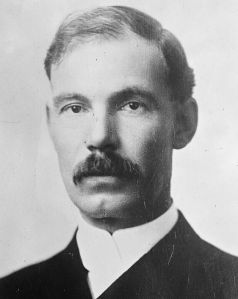
Helen P. Sorokin
A Study of Meiosis in Ranunculus acris
American Journal of Botany, Vol. 14, No. 2 (February 1927), pp. 76-84
Helen Sorokin – American J of Botany, February 1927 (2)
Helen Sorokin
The Chromosomes of Ranunculus acris
The American Naturalist, Vol. 61, No. 677 (November-December 1927), pp. 571-574
Helen Sorokin – American Naturalist, Nov-Dec 1927 (2)
Helen Sorokin
Variation in Homoeotypic Division in Ranunculus acris
American Journal of Botany, Vol. 14, No. 10 (December 1927), pp. 565-581
Helen Sorokin – American J of Botany, December 1927 (2)
A. L. Sommer and Helen Sorokin
Effects of the Absence of Boron and of Some Other Essential Elements on the Cell and Tissue Structure of the Root Tips of Pisum sativum
Plant Physiology, Vol. 3, No. 3 (July 1928), pp. 237-260
A. L. Sommer and Helen Sorokin – Plant Physiology, July 1928 (2)
Helen Sorokin and Anna L. Sommer
Changes in the Cells and Tissues of Root Tips Induced by the Absence of Calcium Author(s):
American Journal of Botany, Vol. 16, No. 1 (January 1929), pp. 23-39
Helen Sorokin and Anna L. Sommer – American J of Botany, January 1929 (2)
Helen Sorokin
Idiograms, Nucleoli, and Satellites of Certain Ranunculaceae
American Journal of Botany, Vol. 16, No. 6 (June 1929), pp. 407-420
Helen Sorokin – American J of Botany, June 1929 (2)
Helen Sorokin
Mitochondria and Plastids in Living Cells of Allium Cepa
American Journal of Botany, Vol. 25, No. 1 (January 1938), pp. 28-33
Helen Sorokin – American J of Botany, January 1938 (2)
Helen Sorokin and Anna L. Sommer
Effects of Calcium Deficiency Upon the Roots of Pisum sativum
American Journal of Botany, Vol. 27, No. 5 (May 1940), pp. 308-318
Helen P. Sorokin and Anna L. Sommer – American J of Botany, May 1940 (2)
Helen Sorokin
The Distinction between Mitochondria and Plastids in Living Epidermal Cells
American Journal of Botany, Vol. 28, No. 6 (June 1941), pp. 476-485
Helen Sorokin – American J of Botany, June 1941 (2)
Helen P. Sorokin
Mitochondria and Spherosomes in the Living Epidermal Cell
American Journal of Botany, Vol. 42, No. 3 (March 1955), pp. 225-231
Helen P. Sorokin – American J of Botany, March 1955 (2)
Helen P. Sorokin
Mitochondria and Precipitates of A-Type Vacuoles in Plant Cells
Journal of the Arnold Arboretum, Vol. 36, No. 2/3 (April-July 1955), pp. 293-304 (published by Arnold Arboretum of Harvard University)
Helen P. Sorokin – J of the Arnold Arboretum, April-July 1955 (2)
Helen P. Sorokin and Sergei Sorokin
Staining of Mitochondria with Neotetrazolium Chloride
American Journal of Botany, Vol. 43, No. 3 (March 1956), pp. 183-190
Helen P. Sorokin and Sergei Sorokin – American J of Botany, March 1956 (2)
Helen P. Sorokin
Studies on Living Cells of Pea Seedlings. I. Survey of Vacuolar Precipitates, Mitochondria, Plastids, and Spherosomes
American Journal of Botany, Vol. 43, No. 10 (December 1956), pp. 787-794
Helen P. Sorokin – American J of Botany, December 1956 (2)
Helen P. Sorokin
Studies on Living Cells of Pea Seedlings. II. Intercellular Tubular Matter
Helen P. Sorokin
American Journal of Botany, Vol. 45, No. 6 (June 1958), pp. 504-513
Helen P. Sorokin – American J of Botany, June 1958 (2)
Helen P. Sorokin, S. N. Mathur and Kenneth V. Thimann
The Effects of Auxins and Kinetin on Xylem Differentiation in the Pea Epicotyl
American Journal of Botany, Vol. 49, No. 5 (May-June 1962), pp. 444-454
Helen P. Sorokin et al. – American J of Botany, May-June 1962 (2)
Helen P. Sorokin
Why Should We Subscribe to a Translation of Doklady?
AIBS Bulletin, Vol. 12, No. 3 (June 1962), pp. 35-56
Helen P. Sorokin
The Destruction of Xylem by a Plasmodial Parasite in Seedlings of Pisum sativum
American Journal of Botany, Vol. 51, No. 3 (March 1964), pp. 299-306
Helen P. Sorokin – American J of Botany, March 1964 (2)
Helen P. Sorokin
The Spherosomes and the Reserve Fat in Plant Cells
American Journal of Botany, Vol. 54, No. 8 (September 1967), pp. 1008-1016
Helen P. Sorokin – American J of Botany, September 1967 (2)
— posted by Roger W. Smith
February 2022
 Pitirim Alexandrovich Sorokin