See my post
“Opinions are not the rules for actions.”
at
— Roger W. Smith
See my post
“Opinions are not the rules for actions.”
at
— Roger W. Smith
Peter Pitirimovich Sorokin obit – PNAS
Peter Pitirimovich Sorokin obit – Physics Today
re Peter P. Sorokin discoveries – NY Herald Tribune 12-15-1960 (2)
Peter P. Sorokin awarded patent for new laser – NY Times 4-25-1964 (2)
Peter Sorokin marriage – Los Angeles Times 12-4-1977 (2)

The family of Sorokin and the careers of his two sons are of intrinsic interest to me.
I have posted here items re Sorokin’s oldest son, Peter P. Sorokin (1935-2015). They are self-explanatory.
— Roger W. Smith
I have always wanted to hear a recording of Sorokin lecturing and what his voice sounded like. I recall reading somewhere that his pronunciation in English was atrocious — it was something that, despite his linguistic skills, he never became proficient at.
Now, thanks to the Pitirim A. Sorokin Foundation, we have such a recording, available online at
This recording is from a Sorokin lecture entitled “The Mysterious Energy of Love” and is from an original tape that belonged to Sorokin. The recording is comprised of a fragment approximately ten minutes in length from the entire lecture, which was two and a half hours long.
The lecture was given in 1959 at an undisclosed university.
See transcript in my post
“The Mysterious Energy of Love”
— recorded by Roger W. Smith
January 2022
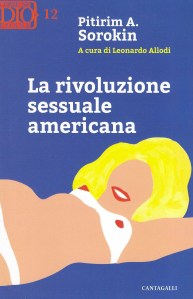

Just published:
Pitirim A. Sorokin
La rivoluzione sessuale americana
translated by Tommaso Allodi
introduction by Leonardo Allodi
paperback
Edizioni Cantagalli, 2021
“Sorokin always wanted to go back to Russia and be received again in his home university.* As time went on and he became successful in the U.S.A., this idea became more and more important to him. His hopes for that were particularly high after the death of Stalin. However, he mentioned a number of times that he would not dare return to Russia unless Khrushchev himself told him that it was all right and removed any danger from such a trip. He did send all his books and publications back to the library of his University — Leningrad. Nothing came of this in relation to forgiveness or elimination of the exile terms to himself. In 1958 we went together to West Germany to a meeting of the International Institut de Sociologie. After our week of formal meetings the German Universities arranged for all of us to have a week’s conduct tour together through East Germany to West Berlin and back to see the situations [sic] there. Sorokin did not at that time feel that he dared even cross over territory occupied by the Russians because the alternative to his banishment was death. I may have imaged these thoughts of Sorokin, but at least they have lived with me for some years.”
— Carle C. Zimmerman, Sorokin: The World’s Greatest Sociologist: His Life and Ideas on Social Time and Change (Saskatoon, Saskatchewan, Canada: University of Saskatchewan, 1968), pg. 86
*Saint Petersburg Imperial University, now Saint Petersburg State University
— posted by Roger W. Smith
November 2021
‘Another Russian Prophet’ – The Indianapolis Star 11-23-1923
Posted here, the following article about Sorokin:
Another Russian Prophet.
The Indianapolis Star
November 22, 1923
pg. 6
— posted by Roger W. Smith
November 2021
A most interesting article has been posted on line and brought to my attention by its author:
“What benefit does Russia derive from this Institute?” Tsar Nicholas II on the Psycho-Neurological Institute: The last Emperor of Russia and Vladimir Bekhterev’s Psycho-Neurological Institute revolutionaries
by Federico Soldani
29th Oct 2021
Sorokin was a student at the Psycho-Neurological Institute.
As Soldani notes: “The Institute offered medical training of the highest order, but its students’ revolutionary tendencies were becoming a concern for the government. In 1912, the mayor of Saint Petersburg had reported on political activity among the capital’s students. In margin of the section on the Psycho-Neurological Institute, Tsar Nicholas II had written, “What benefit does Russia derive from this Institute? I wish to have a well-founded answer”. In the spring of 1914 the minister of public education presented an additional report on the anti-governmental attitudes of Bekhterev’s students and recommended the Institute’s closure.”
Sorokin, City and Country – Heritage 2021 ENGLISH
Sorokin, City and Country – Heritage 2001 RUSSIAN
Sorokin, ‘City and Country’ RUSSIAN
Sorokin, ‘City and Country’ ENGLISH
Natalia Sergieva and Roger W. Smith collaborated on a translation of Sorokin’s article, published in Prague in 1923; and published commentary in the following articles:
П.А. Сорокин, Город И Деревня (Биосоциологическая Характеристика), Наследие. 2021, № 1(18). – с.154-169 … По Изданию: Сорокин П.А. Город и Деревня: Биосоциологическая Характеристика // Крестьянская Россия. IV. Прага, 1923. – C.3–23
Pitirim Sorokin, “City And Country (Bio-Sociological Characteristics),” Nasledie [Heritage]. 2021, No. 1 (18), pp. 174-189 … According to the publication: P. A. Sorokin, “City and Country: Biosociological Characteristics,” Peasant Russia IV (Prague, 1923). pp. 3-23 … translated by Natalia S. Sergieva and Roger W. Smith
Сергиева Н.С., Смит Р.В. О статье Питирима Сорокина «Город и деревня» (Прага, 1923) Наследие. 2021, № 1(18). – с.150–153
Natalia S. Sergieva and Roger W. Smith, “About Pitirim Sorokin’s Article ‘City And Country’ (Bio-Sociological Characteristics)’ (Prague, 1923).” Nasledie [Heritage]. 2021, No. 1 (18), pp. 170–173.
— posted by Roger W. Smith
September 2021; updated March 2024
‘Town Rallies Behind War Relief’ – Winchester Chronicle
75 years ago: Town rallies behind Russian War Relief
By Ellen Knight
The Daily Times Chronicle (Winchester, MA)
June 13, 2017

Russian benefit – Boston Globe 12-15-1941
–– posted by Roger W. Smith
September 2021
“There were other interesting ways in which intensity of feeling showed itself in irrational ways, showing how human good scholars can be.
“During my editorship of the ASR [American Sociological Review] the president of SSSP [The Society for the Study of Social Problems] sent in a proposed constitution for that organization, requesting that it be published in the ASR. Since the Review never had a policy of printing constitutions of other societies (or even that of the ASA!), the paper was returned. My reward was a denunciation in a Council meeting and a further drubbing in a letter to the president of ASA, with copies to various other leading sociologists.
“Even more absurd was a request from P.A. Sorokin, who demanded that I publish a statement accusing Talcott Parsons of plagiarism from Sorokin’s works. This was not the product of a reasonable mind; his principal argument was that Parsons had based a theory on the three elements of society, culture, and personality–an idea that was clearly in the public domain. On receiving a rejection, Sorokin responded with an angry letter, threatening to publish the statement elsewhere and to add that it had been refused by me, Editor of ASR. I terminated the correspondence by writing that if he did, he should add that the Editor had submitted the statement to every associate editor and that each one had recommended against printing it. I never learned if he attempted to publish it elsewhere.”
— “Recollections of a Half Century of Life in the ASA,” By Robert E. L. Faris, The American Sociologist, Vol. 16, No. 1 (February , 1981), pp. 51-52
— posted by Roger W. Smith
August 2021
 Pitirim Alexandrovich Sorokin