that which war and revolution unleash (Sorokin, 1922)


И война, и революция представляют могучие факторы изменения поведения. Они «отвивают» от людей одни формы актов и «прививают» новые, переодевают человека в новый костюм поступков.

Являясь противоположностью мирной жизни, они прививают населению свойства и формы поведения, обратные первой… Мирная жизнь тормозит акты насилия, убийства, зверства, лжи, грабежа, обмана, подкупа и разрушения. Война и революция, напротив, требуют их, прививают эти рефлексы, благоприятствуют им всячески. Убийство, разрушение, обман, насилие, уничтожение врага они возводят в доблесть и заслугу: выполнителей их квалифицируют как великих воинов и бесстрашных революционеров, вместо наказания одаряют наградой, вместо порицания ‒ славой. Мирная жизнь развивает продуктивную работу, творчество, личное право и свободу; война и революция требуют беспрекословного повиновения («повинуйся, а не рассуждай», «подчиняйся революционной дисциплине»), душат личную инициативу, личную свободу («дисциплина», «диктатура», «военные суды», «революционные трибуналы»), прививают и приучают к чисто разрушительным актам, отрывают и отучают от мирного труда. Мирная жизнь внедряет в население переживания благожелательности, любви к людям, уважения к их жизни, правам, достоянию и свободе. Война и революция выращивают и культивируют вражду, злобу, ненависть, посягательство на жизнь, свободу и достояние других лиц. Мирная жизнь способствует свободе мысли. Война и революция тормозят ее. «Где борьбу решает насилие ‒ все равно: насилие ли пушек или грубое насилие нетерпимости, ‒ там победа мудрых, положительная селекция по силе мозга и самая работа мысли затрудняется и делается невозможной».


Both war and revolution are powerful factors in changes in behavior. They “unleash” from people actions in some form or other and “instill” new ones, dress a person in a new costume of deeds.

Manifesting themselves as the opposite of peaceful life, they instill in the population attributes and forms of behavior the opposite of the first … Peaceful life hinders acts of violence, murder, brutality, lies, robbery, deception, bribery and destruction. War and revolution, on the contrary, demand them, inculcate these reflexes, and favor them in every possible way. They elevate murder, destruction, deception, violence, and annihilation of the enemy to valor and merit: they qualify their implementers as great warriors and fearless revolutionaries, give rewards instead of punishment and glory instead of censure. Peaceful life fosters productive work, creativity, personal rights and freedom; war and revolution demand unquestioning obedience (“obey, not reason,” “obey revolutionary discipline”), stifle personal initiative and personal freedom (“discipline,” “dictatorship,” ”military courts,” “revolutionary tribunals”), inculcate and accustom to purely destructive acts, detach and wean from peaceful labor. Peaceful life instills in the population feelings of benevolence, love for people, respect for their lives, rights, property and freedom. War and revolution cultivate and nurture enmity, malice, hatred, encroachment on the life, freedom and property of others. Peaceful life promotes freedom of thought. War and revolution hinder it. “Where the struggle is resolved by violence ‒ it is all the same whether the violence of cannons or the brutal violence of intolerance ‒there the victory of intelligent, positive selection according to the power of the brain, and mental activity itself becomes difficult and impossible.”


— от Питирима Сорокина, Современное состояние России (Прага, 1922 г.), перевод Натальи С. Сергиевой и Роджера В. Смита (перевод в процессе)

from Pitirim Sorokin, Sovremennoye Sostoyaniye Rossii (The Present State of Russia, Prague, 1922), translated by Natalia S. Sergieva and Roger W. Smith (translation in progress)


*****************************************************

There is a timeless quality to much of Sorokin’s writings. The title of Yuri Doykov’s biography, Питирим Сорокин: Человек вне сезона (Pitirim Sorokin: A Timeless Man), is very apt. Consider the current invasion of Ukraine.


— posted by Roger W. Smith

     August 2022

‘West going to dogs,’ Say Sorokin, Wellock; ‘Not So,’ Rebuts Aiken


‘West going to dogs.’ says Sorokin (not so, rebuts Aiken) – Harvard Crimson 12-4-1946

Posted here (downloadable Word document above):

‘West going to dogs,’ Say Sorokin, Wellock; ‘Not So,’ Rebuts Aiken

The Harvard Crimson

December 4, 1946

A personal note: I took a course with Professor Aiken: “Nature and Value,” Humanities 12b, at Brandeis University. My father, Alan W. Smith, took the courses Social Relations 1a and Social Relations 1b at Harvard during the 1948-49 academic year. Sorokin was not teaching them at the time. Social Relations 1a was taught by Gordon W. Allport. Social Relations 1b was taught by George Homans.


— posted by Roger W. Smith

     July 2022

“The 50 years since The Crisis of Our Age have only reinforced the accuracy of his analysis.” (Harold O. J. Brown on Sorokin)


Harold O. J. Brown, ‘Regression and Renewal’ – Chronicles, January 1992


Posted here (downloadable Word document above):

Harold O. J. Brown

“Regression and Renewal”

Chronicles: A Magazine of American Culture

January 1, 1992

Harold O. J. Brown (1933-2007) was a professor of theology at Trinity Evangelical Divinity School in Deerfield, Illinois. He graduated from Harvard College in 1953 and earned two degrees from Harvard Divinity School and a Ph.D. from Harvard University.


— posted by Roger W. Smith

     July 2022


The Crisis of Our Age, paperback edition


Myra Page on Sorokin


‘In a Generous Spirit’ (Myra Page; excerpts)


Posted here (PDF above) are excerpts from In a Generous Spirit: A First-Person Biography of Myra Page, by Christina Looper Baker (University of Illinois Press, 1996)

Myra Page studied under Sorokin at the University of Minnesota.


*****************************************************

adapted from Wikipedia:

Myra Page was the pen name of Dorothy Markey (born Dorothy Page Gary, 1897–1993), an American communist writer, journalist, union activist, and teacher.

Page was born in Newport News, Virginia. She received a bachelor’s degree in English and history from Westhampton College (now the University of Richmond). She taught school in Richmond and then began graduate studies at Columbia University. She studied anthropology under Franz Boas, Melvin Herskovitz, and Franklin Giddings. She also took a class under John Dewey at Columbia’s Teacher’s College and attended courses given by theologians Harry Emerson Fosdick and Henry F. Ward at Union Theological Seminary. In 1920, she obtained a masters with a thesis that analyzed the effect of New York newspaper coverage on the Spanish–American War.

While a graduate student, she became active in the Young Women’s Christian Association (YWCA), which at that time championed reform in race relations. Influenced by Social Gospel, she “developed an antiracist consciousness and chafed against the restrictions imposed upon her as a southern white woman.” Upon completing her master’s degree in 1920, Page became a YWCA “industrial secretary” at a silk factory in Norfolk, Virginia and organized education for women workers.

Giddings had introduced Page to the Rand School of Social Science, where she had met Anna Louise Strong, Mary Heaton Vorse, and Scott Nearing. In 1921, she returned to New York from Norfolk and studied further under Nearing at the Rand School; at that time, she first read The Communist Manifesto.

She then took a factory job in Philadelphia and became a union organizer for the Amalgamated Clothing Workers Union (ACW). She worked at several jobs including pants seamstress and secretary. . In the spring of 1924, she returned to the New York area, became a teacher of American History in Teaneck, New Jersey, joined the American Federation of Teachers, and became one of its leaders.

In fall 1924, she got a teaching fellowship in the History Department of the University of Minnesota, chaired by F. Stuart Chapin. Pitirim Sorokin was a professor there. She married fellow teacher and fellow John Markey.

In June 1928, Page earned her Ph.D. in Sociology with double minor in Economics and Psychology from the University of Minnesota. In the fall of 1928, she accepted a teaching position at Wheaton College.

At the end of the 1929–1930 academic year, Page and her husband left Wheaton College. Page became a political journalist and writer and wrote for Communist publications such as the Daily Worker.

Page spent two years in Moscow, whence she wrote for American socialist journals as well as the Soviet communist publication Moscow News. She also wrote a novel Moscow Yankee (1935) there.

Upon their return to the States in 1933, Page and her husband lived in Brooklyn, New York. Page joined the editorial board of Soviet Russia Today, a Soviet-backed magazine, and the League of American Writers. In March 1937, she interviewed Andre Malraux for his views on the Spanish Civil War.

Page eventually left the Communist Party: “I left the Party in 1953, having lost faith that it could do the job it was supposed to do. My disillusionment was gradual… Gradually, we just plain lost confidence in the party.”


— posted by Roger W.  Smith

     July 2022


photo of Moscow Rizhsky railway station (now the Riga railway station)


From which Sorokin and his wife left for Riga, Latvia; Prague; and overseas:

On a gray afternoon September 23 1922 the first group of exiles gathered at the Moscow railway station. I carried our two valises into the Lettish diplomatic car. “Omnia mea mecum porto” I could say of myself. In a pair of shoes sent me by a Czech scientist a suit donated by the American Relief Administration and with fifty rubles in my pocket I left my native land. All my companions were in a similar plight but none of us worried very much. In spite of prohibitions of the authorities many friends and acquaintances came to see us off with gifts of flowers handclasps and tears. We all devoured with our eyes their faces the disappearing streets of Moscow the last glimpse of the fatherland.

Next day we reached Sebage the boundary line of Russia. Half an hour later we passed a Red flag-and Soviet Russia was behind us. That night after five years we lay down to sleep without asking ourselves the question ‘Will they come tonight or not?”

A Long Journey: The Autobiography of Pitirim A. Sorokin, pg. 196

— posted by Roger W. Smith

July 2022

Photo courtesy my good friend and fellow scholar Yuri Doykov

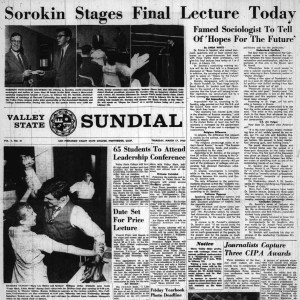
“Sorokin Stages Final Lecture Today: Famed Sociologist To Tell Of ‘Hopes For The Future’ ”


‘Sorokin Stages Final Lecture Today’ – Valley State Sundial 3-17-1960 pg 1 (2)


Posted here:

“Sorokin Stages Final Lecture Today: Famed Sociologist To Tell Of ‘Hopes For The Future’ ”

Valley State Sundial

March 17, 1960

The Valley State Sundial was the student newspaper of San Fernando Valley State College. The college adopted its s current name of California State University, Northridge in 1972.

Sorokin made a lecture tour in California in 1962. See his autobiography, A Long Journey, pg. 314.


— posted by Roger W. Smith

      July 2022

Sorokin’s early reading


Питирим Сорокин аккуратно записывал в дневник назва-ния прочитанных им книг и авторов: 4 тома А.  П.  Чехова, Ф.  М.  Достоевского  — «Преступление и наказание», «Дневник писателя», «Бедные люди» и другие. Огромное впечатление произвел на него «Идиот». Дальше идут книги A.M.  Горького, И.  А.  Гончарова, Г.  Сенкевича, Н.  А.  Некрасова, Л.  Н.  Толстого, У.  Шекспира, П.  В.  Засодимского. В.Гюго, A.M.  Скабичевского, Г.  И.  Успенского, А.  И.  Писарева, выписки из древнегреческих философов: Демокрита, Гераклита, Пифагора, Анаксагора, Про-тагора, Сократа. Среди прочитанных книг — работы B.C.  Соло-вьева, Гегеля, В.Чернова («Монистическая точка зрения в исто-рии и психологии», «К вопросу о капитализме и крестьянстве»), М. И. Туган-Барановского («Теоретические основы марксизма»), В.  И.  Ленина («Проект аграрной программы» и др.) а также книги В.  И.  Засулич и «Прошлое Шлиссельбургской крепости» В.  Панкратова, «Популярные очерки политической экономии» П.  Кропоткина.

— Дойков, Юрий, Питирим Сорокин, Человек вне сезона: Биография. Том 1 (1889–1922); Архангельск, 2008., стр. 23


Pitirim Sorokin carefully recorded in his diary the names of the books and authors he read: 4 volumes by A. P. Chekhov, F. M. Dostoevsky – “Crime and Punishment”, “Writer’s Diary”, “Poor People” and others. The Idiot made a huge impression on him. Then there are books by A. M. Gorky, I. A. Goncharov, G. Senkevich, N. A. Nekrasov, L. N. Tolstoy, W. Shakespeare, P. V. Zasodimsky. V. Hugo, A. M. Skabichevsky, G. I. Uspensky, A. I. Pisarev, extracts from ancient Greek philosophers: Democritus, Heraclitus, Pythagoras, Anaxagoras, Protagoras, Socrates. Among the books read are the works of B.C. Soloviev, Hegel, V. Chernov (“The Monistic Point of View in History and Psychology”, “On the Question of Capitalism and the Peasantry”), M. I. Tugan-Baranovsky (“Theoretical Foundations of Marxism”), V. I. Lenin (“The Project of the Agrarian Program”, etc.), as well as books by V. I. Zasulich and “The Past of the Shlisselburg Fortress” by V. Pankratov, “Popular Essays on Political Economy” by P. Kropotkin.

Yuri Doykov, Pitirim Sorokin: A Timeless Man; A Biography, Volume 1 (1889-1922); Arkhangelsk, 2008, pg. 23


— posted by Roger W. Smith

      April 2022

“Use of A-Bomb Condemned”


‘Use of A-Bomb Condemned’ – NY Times 8-3-1955

Posted here (PDF file above):

Use of A-Bomb Condemned: Group Notes Tenth Anniversary of Bombing of Hiroshima

letter to editor

The New York Times

August 3, 1955

The signers were Clarence E. Pickett, Bishop W. Appleton Lawrence, Lewis Mumford, Pitirim A. Sorokin, W. Harold Row, A. Philp Randolph, Orie O. Miller, Howard Thurman, Henry J. Cadbury, A. J. Muste, Roland H. Bainton, and Rabbi Isidor B. Hoffman.


— posted by Roger W. Smith

     March 2022

“Revolutionary Gardener”


“Revolutionary Gardener”

Faculty Profile

By Dennis E. Brown

The Harvard Crimson

May 1, 1954


One morning nearly five years after the Russian Revolution of 1917, an article headlined “Professor Sorokin” appeared in Pravda. Written by Lenin himself, the article stated that though Sorokin had never agreed with the Bolsheviks, he was a true revolutionary at heart. Russia, Lenin concluded, “needs his mind.”

To the man who had spent weeks in an over-crowded prison in north Russia, this statement meant an unexpected salvation. Each day between the hours of four and twelve, guards had entered his cellblock to read off a list of names. “This was a kindly invitation to be shot,” Sorokin recalls, and he adds that most of the prisoners were almost willing to accept. The prison conditions were bad, food was nearly as limited at space, and disease was a commonplace.

But once freed, Sorokin still refused to collaborate with the Bolsheviks and after several close escapes, managed to smuggle himself out of the country. “What a relief,” he recalls, “to cross the border and know that this time they could not come after me.” Sorokin’s last flight from Russia marked the end of an active, fifteen-year career as a revolutionary and gave him the opportunity to continue his work in sociology. Before leaving Russia in 1922, he had become prominent in both fields.

Sorokin usually attributes his early rise in Russia’s political and educational circles to “mistaken ideas about my ability” and “just plain luck.” To ability and chance, his friends would add firm conviction and a tenacity which has brought him both trouble, in the form of political imprisonment, and fame. “This is my stubbornness,” he says: “I regard it a man’s main duty to tell the truth as he sees it.”

As early as 1905, Professor Sorokin was telling his truths to factory workers and villagers in his own Russian district. The son of an artisan, he understood the working class, and because of his talents as an orator and pamphleteer, he soon became a top leader in the Social Revolutionary Party.

Underground Lessons

The years of political activity that followed were lessons in the technique of the underground. Police methods under the Tsars were comparatively lenient, he discovered, because the dying regime was old and soft. Often prisons became centers of revolutionary activity. But the “super heated Turkish bath” that followed 1917 was another matter. Sorokin had enjoyed a few months respite under the Kerensky government as secretary to the Prime Minister and editor of the party newspaper. When the Bolsheviks stormed the Petrograd Garrison, however, it meant that the other socialist parties would be again outlawed and persecuted.

Looking back at his experiences with the Bolsheviks, Sorokin remembers some lighter incidents, although he was hunted almost continually by the secret police. On one occasion, he was sentenced to Peter and Paul Prison where he found many of the elite from former regimes and parties. These old political enemies, from Tsarists to Anarchists, decided to issue prison society notes, which began “The social season at Peter and Paul resort opened brilliantly today . . . .”

At other times, it was harder to laugh. During one summer, Sorokin was forced to hide in the forests of northern Russia. Living off whatever food he could find, he remained there until the first snowfall drove him back to the cities.

Throughout the hardships that political activity caused in those times, Sorokin miraculously managed to pursue his studies in sociology. He was a prolific writer, and long before coming to the United States, had published several texts on the subject. In 1923 he came to this country with an invitation to teach at the University of Minnesota. Eight years later, President Lowell asked him to form the first Sociology Department at Harvard. The University had possessed a grant for such a department since 1906, and officials felt that in Sorokin, they at last had a man who could do the job.

Creative Altruism

His job, as chairman of the new department, lasted fourteen years. Professor Sorokin was only too glad to end what he calls his “Roosevelt term” and devote his time to a project he had long considered. A witness to the revolutions in Russia and two world wars, he had lived with violence and always opposed it. In his mind, the one hope for civilization was the development of man’s creative over his destructive impulses. To study the problem, he has established the Harvard Research Center in Creative Altruism.

Sorokin tackles his new work with the vigor of the young revolutionary who debated with Lenin and Trotsky. He has never lost the ability to support a cause he believes in, and does so in characteristically strong language. To his long list of writings, most of which have been translated into other languages, he has added several new volumes on altruism. Pointing proudly to a bulky, orange book on his desk, he remarked, “They are even writing books about my books now.”

His garden in Winchester is a source of pride almost equal to his literary accomplishments. Each year, nearly ten thousand visitors stop to admire the azaleas which he plants and tends alone. This season, as in the past, he predicts a bad year for the flowers, his last touch with the rural Russia of his youth. Almost unfailingly, however, the plants have survived oppressive frosts, and like their gardener, continue to grow.


— posted by Roger W. Smith
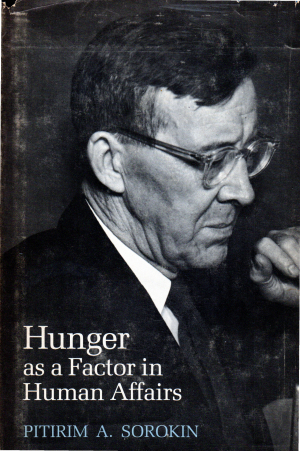
“the fact of stratification is universal”


Any organized social group is always a stratified social body. There has not been and does not exist any permanent social group which is “flat,” and in which all members are equal. Unstratified society, with a real equality of its members, is a myth which has never been realized in the history of mankind. …

Except, perhaps, the few cases where the members of a population are leading an isolated life, where no permanent social life and interaction exist, where, therefore, we do not have a social organization in the proper sense of the word, as soon as organization begins primitive social groups exhibit the trait of stratification. … Traditional opinion about primitive groups as communistic societies which do not have any commerce or private property, or economic inequality, or inheritance of fortune, are far from being correct. …

If we cannot find a non-stratified society among the most primitive groups, it is useless to try to find it among more advanced, larger and compound societies. Here, without any single exception, the fact of stratification is universal. … Among all agricultural and, especially, industrial societies social stratification has been conspicuous and clear. The modern democracies also do not present any exception to the rule. Though in their constitutions it is said that “all men are equal,” only a quite naive person may infer from this a non-existence of social stratification within these societies. It is enough to mention the gradations: from Henry Ford to a beggar; from the President of the United States to a policeman; from a foreman to the most subordinate worker; from the president of a university to a janitor; from an “LL.D.” or “Ph.D.” to a “B.A.”; from a “leading authority” to an average man; from a commander-in-chief of an army to a soldier; from a president of a board of directors of a corporation to its common laborer; from an editor-in-chief of a newspaper to a simple reporter; it is enough to mention these various ranks and social gradations to see that the best democracies have social stratification scarcely less than the non-democratic societies. …

Family, church, sect, political party, faction, business organization, gang of brigands, labor union, scientific society—in brief, any organized social group is stratified at the price of its permanency and organization. The organization even of groups of ardent levelers, and the permanent failure of all attempts to build a non-stratified group, testify to the imminency and unavoidability of stratification in an organized social group. This remark may appear somewhat strange to many people who, under the influence of high-sounding phraseology, may believe that, at least, the societies of the levelers themselves are non-stratified. This belief, as many another one, is utterly wrong. Different attempts to exterminate social feudalism have been successful, in the best cases, only in ameliorating some of the inequalities, and in changing the concrete forms of stratification. They have never succeeded in annihilating stratification itself. … all attempts of the most ardent levelers in the history of all countries have had the same fate. They could not avoid it even when the faction of the levelers has been victorious. The failure of the Russian Communism is only an additional example in a long series of similar experiments performed on small and large scale, sometimes peacefully, as in many religious sects, sometimes violently, as in social revolutions of the past and present. If many forms of stratification were destroyed for a moment, they regularly reappeared again in the old or in a modified form, often being built by the hands of the levelers themselves.

Present democracies and Socialist, Communist, Syndicalist, and other organizations, with their slogan of “equality” do not present any exception to the rule. In regard to democracies this has been shown above. … The enormous potential taste for inequality of numerous “levelers” becomes at once conspicuous, as soon, indeed, as they happen to be victorious. In such cases they often exhibit a greater cruelty and contempt toward the masses than former kings and rulers. This has been repeated regularly in victorious revolutions where the levelers become dictators. …

Social stratification is a permanent characteristic of any organized society.

Pitirim A. Sorokin, Social Mobility (1927). Chapter II


— posted by Roger W. Smith

       January 2022