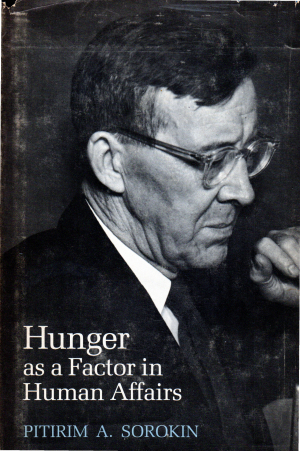
This site, developed and maintained by Roger W. Smith, is devoted to the Russian-American sociologist and social philosopher Pitirim A. Sorokin (1889-1968).
“The biggest noise in an empty barrel for the year,” said Clifton Fadiman in the New Yorker. “He is to me like God,” wrote an awestruck Freshman in the Confidential Guide poll last spring. “The world’s foremost sociologist,” was the opinion of a professor in a midwestern university. In panning Sorokin’s book on “Social and Cultural Dynamics,” Fadiman referred to Harvard’s Department of Sociology as a “White Russian WPA.”* But Professor Sorokin, who is head of that WPA, began his career by being just as red as the rest of his intellectual, revolutionary friends. Back in 1916 in Petrograd, as a young lecturer, his ideas were well tinged with Utopian visions of a socialistic Russia. But his part in the “great experiment” was that played by so many moderates in so many revolutions, only with a happier ending. As he fed the Russian bear, it turned around and bit him. “In a revolution, power lies in the street for any one to pick up,” he wrote in one of his innumerable books. He stepped into the street just long enough to pick up a job as Secretary to Prime Minister Kerensky in the fall of 1917, but that success was so short-lived that soon he had to grow a beard to escape detection by the Bolsheviks who had seized power and were after him. As the blue blood began to run, and the red as well, Sorokin became sickened by the cruelty and irresponsibility of the anarchists and turned counter-revolutionary. He spent fifty days in the Petropavlovskaia Fortress, another word for Bastille, for having “attempted to assassinate Lenin.” It turned out that what they thought was a pistol shot had only been a tire blowout, but he was kept in prison for good measure. Writing anti-government pamphlets and articles was not a healthy occupation in Russia in 1918, and soon Sorokin found himself sentenced to death. At the last minute he was saved by a combination of luck and the work of a friend who must have put in a good word with Lenin. Back in Petrograd teaching again, on precarious academic tenure, he found it impossible to indoctrinate the sons of the proletariat with the first principles of sociology. He contrived to get himself banished from Russia in 1923, and from then on the tempo of the Sorokin drama relaxed. A short term of lecturing in Prague, then on to America. Professor at the University of Minnesota until 1930, and at Harvard since then.
Professor Sorokin now lives in Winchester, with the Mystic Valley Reservation for a back yard, which gives him “all the advantages of an estate without any of the duties.” When he is not lecturing or writing or breakfasting with his friend Serge Koussevitsky, the professor likes to work in his garden behind the house, an interest perhaps inherited from his many Russian forebears. When they want more lengthy relaxation. Mother and Father and the two boys move to their camp in Canada where Father forgets his vertical and horizontal mobility long enough to be a compleat angler. He despairs of modern jazz, movies, radio, advertising, and has a high unconcern for the press. He is above all criticism, good or bad, from a world whose culture and civilization are degenerate. He has an enormous and un-selfconscious ego concerning the immortality of his works, but won’t budge form the assertion that none of the modern greats correspond in ability to those of the past. “When there are no fish, a crawfish is a fish,” he says. “I am a crawfish.” Yet he has doubled the size of Harvard’s Sociology Department, attracted a brilliant group of graduate students, and has probably written as many books in his field as any man in history. Although he scorns the “sensational, vulgar, misleading, and distorting press,” he manages to cull yearly as much publicity as the average Hollywood starlet.
Personally, Professor Sorokin is as pleasant and charming an egoist as it is possible to find at Harvard, home of many successful men. His eyes, behind steel-rimmed glasses, glitter smilingly with every word he utters. Some people who take his courses groan that they can’t understand a word he says. A little judicious listening, coupled with the immunity gained after a few of his lectures, should fix that. Short, boyishly cut gray hair, a rapid and brusque manner, make him seem a tall little man. A conversation with Sorokin requires an effort to keep up with his wit, and when he gets serious, an effort to grasp what he is talking about. For him, the best art, literature, and music was produced before the nineteenth century. Enough of a cosmopolite to prefer Bach, Beethoven, and Mozart to Tchaikovsky and Rimsky Korsakov, smoke English instead of Russian cigarettes, keep cases of French wine in his cellar instead of scotch or vodka, and obtain American citizenship in 1930, he is nevertheless simple and quiet in taste, abhorring social life and all that it entails. However, the professor continues to sling his provoking social theories into the intellectual boxing ring, and although they get slammed around quite a bit there’s no reason why he shouldn’t come out a winner in the end.
* Porter Sargent , a former Harvard professor, publisher, and commentator and critic of higher education. was quoted in an article in Time (May 30, 1938) as follows: “The [Harvard] sociology department is the White Russian WPA.” This quote was misattributed by the Crimson writer to Clifton Fadiman.
Питирим Сорокин аккуратно записывал в дневник назва-ния прочитанных им книг и авторов: 4 тома А. П. Чехова, Ф. М. Достоевского — «Преступление и наказание», «Дневник писателя», «Бедные люди» и другие. Огромное впечатление произвел на него «Идиот». Дальше идут книги A.M. Горького, И. А. Гончарова, Г. Сенкевича, Н. А. Некрасова, Л. Н. Толстого, У. Шекспира, П. В. Засодимского. В.Гюго, A.M. Скабичевского, Г. И. Успенского, А. И. Писарева, выписки из древнегреческих философов: Демокрита, Гераклита, Пифагора, Анаксагора, Про-тагора, Сократа. Среди прочитанных книг — работы B.C. Соло-вьева, Гегеля, В.Чернова («Монистическая точка зрения в исто-рии и психологии», «К вопросу о капитализме и крестьянстве»), М. И. Туган-Барановского («Теоретические основы марксизма»), В. И. Ленина («Проект аграрной программы» и др.) а также книги В. И. Засулич и «Прошлое Шлиссельбургской крепости» В. Панкратова, «Популярные очерки политической экономии» П. Кропоткина.
— Дойков, Юрий, Питирим Сорокин, Человек вне сезона: Биография. Том 1 (1889–1922); Архангельск, 2008., стр. 23
Pitirim Sorokin carefully recorded in his diary the names of the books and authors he read: 4 volumes by A. P. Chekhov, F. M. Dostoevsky – “Crime and Punishment”, “Writer’s Diary”, “Poor People” and others. The Idiot made a huge impression on him. Then there are books by A. M. Gorky, I. A. Goncharov, G. Senkevich, N. A. Nekrasov, L. N. Tolstoy, W. Shakespeare, P. V. Zasodimsky. V. Hugo, A. M. Skabichevsky, G. I. Uspensky, A. I. Pisarev, extracts from ancient Greek philosophers: Democritus, Heraclitus, Pythagoras, Anaxagoras, Protagoras, Socrates. Among the books read are the works of B.C. Soloviev, Hegel, V. Chernov (“The Monistic Point of View in History and Psychology”, “On the Question of Capitalism and the Peasantry”), M. I. Tugan-Baranovsky (“Theoretical Foundations of Marxism”), V. I. Lenin (“The Project of the Agrarian Program”, etc.), as well as books by V. I. Zasulich and “The Past of the Shlisselburg Fortress” by V. Pankratov, “Popular Essays on Political Economy” by P. Kropotkin.
Yuri Doykov, Pitirim Sorokin: A Timeless Man; A Biography, Volume 1 (1889-1922); Arkhangelsk, 2008, pg. 23
Use of A-Bomb Condemned: Group Notes Tenth Anniversary of Bombing of Hiroshima
letter to editor
The New York Times
August 3, 1955
The signers were Clarence E. Pickett, Bishop W. Appleton Lawrence, Lewis Mumford, Pitirim A. Sorokin, W. Harold Row, A. Philp Randolph, Orie O. Miller, Howard Thurman, Henry J. Cadbury, A. J. Muste, Roland H. Bainton, and Rabbi Isidor B. Hoffman.
The following letter (in Russian) to the American sociologist Edward A. Ross of the University of Wisconsin was written by Sorokin in July 1922, when Sorokin was in St Petersburg..
ГЛУБОКОУВАЖАЕМЫЙ КОЛЛЕГА!
Позволю себе послать Вам мою небольшую заметку* о Вашей прекрасной книге, случайно попавшей в Петроград, любезно предоставленной мне для прочтения глубокоу-важаемым г. Кини, представителем Христианского Союза молодых людей.
Вместе с этим позволю обратиться к Вам и через Вас другим американским социологам с большой просьбой: мы, русские социологи, до сих пор оторваны от амери-канской и европейской социологии, – книг и журналов. Этот духовный голод чувствуется нами острее, чем мате-риальный. Я лично, выпустивший за эти годы два тома «Системы социологии» (многотомная работа) и «Голод как фактор», не имею литературы зарубежной, вышед-шей после 1916/17 гг. (кроме немногих книг, в частности книг профессора Е. С. Hayes ‘а, любезно им присланных недавно).
Этим Вы очень обрадуете нас и принесете большую пользу. Лично я, как проводник американской социологии в России (и вообще чрезвычайно высоко ставящий Аме-риканское общество), был бы чрезвычайно признателен Вам.
Если правительство России даст мне разрешение – то я намерен через месяца два-три прибыть в Америку и пробыть в ней год или два, чтобы хорошо изучить американскую социологию, многому научиться, а с другой стороны – поделиться и с вами знаниями и, в частности, большим опытом и выводами, полученными из нашего великого трагического эксперимента.
Если Вы позволите – я очень бы желал посетить Вас и поучиться у Вас.
в заключение в позвольте еще обеспокоить Вас одной просьбой. Вам, конечно, известно, что революция сде-лала и ученых бедными. Я еду в Америку без субсидий государства, рассчитывая только на свой мозг и мускулы. Для существования я должен буду искать какой-нибудь работы. Не были бы добры как-нибудь помочь мне в этом отношении? Я готов делать какую угодно работу, не исключая и мускульной, лишь бы она была мне по силам и не была морально унизительной. Я молод (еще 32 года) и жена – преподавательница ботаники в Агрономическом институте (26 лет), и потому мы можем – если не найдется интеллектуальной работы – работать физически.
Вы очень обязали бы нас, если бы помогли нам в этом отношении. Простите за просьбу – нормально не очень тактичную, но наши исключительные ненормальные условия вынуждают к ней и делают в известной мере извинительными».
DEAR COLLEAGUE!
Let me send you my little note about your wonderful book,* which happened to be in Petrograd, kindly provided to me for reading by Mr. Keeny,** a representative of the Young People’s Christian Union.
At the same time, I will take the liberty to address you, and through you, other American sociologists, with a big request: we Russian sociologists are still divorced from American and European sociology, books, and magazines. This spiritual hunger is felt more acutely by us than material hunger. I personally, who over the years have published two volumes of System of Sociology (a multi-volume work) and Hunger as a Factor, have had access to no foreign literature since 1916/17 (except for a few books, in particular the books of Professor E. C. Hayes, kindly sent to them recently).
Under such conditions, perhaps you will not find it a tactless request: to send your works of recent years and to ask other American sociologists and, in particular, The American Journal of Sociology, to do the same generously.
You will greatly please us with this and it will be a great benefit. Personally, as an expositor of American sociology in Russia (and having, in general, an extremely high regard for American society), I would be extremely grateful to you.
If the Russian government gives me permission, then I intend to come to America in two or three months and stay there for a year or two in order to study American sociology in depth, to learn a lot, and on the other hand, to share with you the knowledge and, in particular, the profound experience and conclusions obtained from our great tragic experiment.
If you allow it, I would very much like to visit and learn from you.
Let me further bother you with one request. You know, of course, that the revolution has made scholars poor. I am going to America without state subsidies, relying only on my brain and body. To exist, I will have to look for some kind of work. Would you be kind enough to help me in any way in that regard? I am ready to do any work, not excluding physical, as long as it is within my power and is not morally humiliating. I am young (32 years old) and my wife is a teacher of botany at the Agronomic Institute (26 years old), and therefore we can – if there be no intellectual work – work physically.
You would be very obliged to us if you could help us in this regard. Sorry for the request – which is not per se very tactful, but our exceptionally abnormal conditions necessitate and make it to a certain extent excusable.
— translation from the Russian by Roger W. Smith
*Edward Alsworth Ross, Foundations of Sociology (1905)
**Spurgeon M. (Sam) Keeny, a friend of Sorokin’s, who had served during World War I as a Y.M.C.A. volunteer with the British Army. At the time of Sorokin’s letter, he was serving with the American Relief Administration (ARA) headed by Herbert Hoover.
Probably we would have settled in Czechoslovakia “permanently” as teachers in one of the Czech universities if I had not received invitations from two distinguished American sociologists, Edward C. Hayes of the University of Illinois and Edward A. Ross of the University of Wisconsin. They invited me to come to America to deliver a series of lectures on the Russian Revolution. These unexpected invitations radically changed the course of our subsequent life. For many years before, I had been greatly interested in the United States and had studied American social, economic, and political institutions and theories, American culture, literature, and the way of life. …. I greatly admired the American people, democracy, and way of life. This admiration was seemingly so great that many of my friends and colleagues in Russia even nicknamed me “a Russian-American.”
— A Long Journey: The Autobiography of Pitirim A. Sorokin, pg. 200
Posted here (PDF file above) is the following article:
Сергиева Н.С., Роджер В. Смит, Питирим Сорокин в Вассар Колледже: по материалам местной прессы (Pitirim Sorokin v Vassar Kolledzhe: po materialam mestnoy pressy)
Natalia S. Sergieva and Roger W. Smith, Pitirim Sorokin at Vassar College: Based on Local Press Accounts
Наследие (Heritage), No. 2 (19), 2021, pp. 50-69
An English translation by Roger W. Smith has also been posted here (downloadable Word document above).
The press accounts have been drawn from local newspapers such as the Poughkeepsie Evening Star & Enterprise, the Poughkeepsie Eagle-News, and the Vassar Miscellany News.
A. L. Sommer and Helen Sorokin
Effects of the Absence of Boron and of Some Other Essential Elements on the Cell and Tissue Structure of the Root Tips of Pisum sativum Plant Physiology, Vol. 3, No. 3 (July 1928), pp. 237-260
Helen Sorokin and Anna L. Sommer
Changes in the Cells and Tissues of Root Tips Induced by the Absence of Calcium Author(s):
American Journal of Botany, Vol. 16, No. 1 (January 1929), pp. 23-39
Helen Sorokin and Anna L. Sommer
Effects of Calcium Deficiency Upon the Roots of Pisum sativum American Journal of Botany, Vol. 27, No. 5 (May 1940), pp. 308-318
Helen Sorokin
The Distinction between Mitochondria and Plastids in Living Epidermal Cells American Journal of Botany, Vol. 28, No. 6 (June 1941), pp. 476-485
Helen P. Sorokin
Mitochondria and Precipitates of A-Type Vacuoles in Plant Cells Journal of the Arnold Arboretum, Vol. 36, No. 2/3 (April-July 1955), pp. 293-304 (published by Arnold Arboretum of Harvard University)
Helen P. Sorokin and Sergei Sorokin
Staining of Mitochondria with Neotetrazolium Chloride American Journal of Botany, Vol. 43, No. 3 (March 1956), pp. 183-190
Helen P. Sorokin
Studies on Living Cells of Pea Seedlings. I. Survey of Vacuolar Precipitates, Mitochondria, Plastids, and Spherosomes American Journal of Botany, Vol. 43, No. 10 (December 1956), pp. 787-794
Helen P. Sorokin
Studies on Living Cells of Pea Seedlings. II. Intercellular Tubular Matter
Helen P. Sorokin American Journal of Botany, Vol. 45, No. 6 (June 1958), pp. 504-513
Helen P. Sorokin, S. N. Mathur and Kenneth V. Thimann
The Effects of Auxins and Kinetin on Xylem Differentiation in the Pea Epicotyl American Journal of Botany, Vol. 49, No. 5 (May-June 1962), pp. 444-454
Helen P. Sorokin
The Destruction of Xylem by a Plasmodial Parasite in Seedlings of Pisum sativum
American Journal of Botany, Vol. 51, No. 3 (March 1964), pp. 299-306
One morning nearly five years after the Russian Revolution of 1917, an article headlined “Professor Sorokin” appeared in Pravda. Written by Lenin himself, the article stated that though Sorokin had never agreed with the Bolsheviks, he was a true revolutionary at heart. Russia, Lenin concluded, “needs his mind.”
To the man who had spent weeks in an over-crowded prison in north Russia, this statement meant an unexpected salvation. Each day between the hours of four and twelve, guards had entered his cellblock to read off a list of names. “This was a kindly invitation to be shot,” Sorokin recalls, and he adds that most of the prisoners were almost willing to accept. The prison conditions were bad, food was nearly as limited at space, and disease was a commonplace.
But once freed, Sorokin still refused to collaborate with the Bolsheviks and after several close escapes, managed to smuggle himself out of the country. “What a relief,” he recalls, “to cross the border and know that this time they could not come after me.” Sorokin’s last flight from Russia marked the end of an active, fifteen-year career as a revolutionary and gave him the opportunity to continue his work in sociology. Before leaving Russia in 1922, he had become prominent in both fields.
Sorokin usually attributes his early rise in Russia’s political and educational circles to “mistaken ideas about my ability” and “just plain luck.” To ability and chance, his friends would add firm conviction and a tenacity which has brought him both trouble, in the form of political imprisonment, and fame. “This is my stubbornness,” he says: “I regard it a man’s main duty to tell the truth as he sees it.”
As early as 1905, Professor Sorokin was telling his truths to factory workers and villagers in his own Russian district. The son of an artisan, he understood the working class, and because of his talents as an orator and pamphleteer, he soon became a top leader in the Social Revolutionary Party.
Underground Lessons
The years of political activity that followed were lessons in the technique of the underground. Police methods under the Tsars were comparatively lenient, he discovered, because the dying regime was old and soft. Often prisons became centers of revolutionary activity. But the “super heated Turkish bath” that followed 1917 was another matter. Sorokin had enjoyed a few months respite under the Kerensky government as secretary to the Prime Minister and editor of the party newspaper. When the Bolsheviks stormed the Petrograd Garrison, however, it meant that the other socialist parties would be again outlawed and persecuted.
Looking back at his experiences with the Bolsheviks, Sorokin remembers some lighter incidents, although he was hunted almost continually by the secret police. On one occasion, he was sentenced to Peter and Paul Prison where he found many of the elite from former regimes and parties. These old political enemies, from Tsarists to Anarchists, decided to issue prison society notes, which began “The social season at Peter and Paul resort opened brilliantly today . . . .”
At other times, it was harder to laugh. During one summer, Sorokin was forced to hide in the forests of northern Russia. Living off whatever food he could find, he remained there until the first snowfall drove him back to the cities.
Throughout the hardships that political activity caused in those times, Sorokin miraculously managed to pursue his studies in sociology. He was a prolific writer, and long before coming to the United States, had published several texts on the subject. In 1923 he came to this country with an invitation to teach at the University of Minnesota. Eight years later, President Lowell asked him to form the first Sociology Department at Harvard. The University had possessed a grant for such a department since 1906, and officials felt that in Sorokin, they at last had a man who could do the job.
Creative Altruism
His job, as chairman of the new department, lasted fourteen years. Professor Sorokin was only too glad to end what he calls his “Roosevelt term” and devote his time to a project he had long considered. A witness to the revolutions in Russia and two world wars, he had lived with violence and always opposed it. In his mind, the one hope for civilization was the development of man’s creative over his destructive impulses. To study the problem, he has established the Harvard Research Center in Creative Altruism.
Sorokin tackles his new work with the vigor of the young revolutionary who debated with Lenin and Trotsky. He has never lost the ability to support a cause he believes in, and does so in characteristically strong language. To his long list of writings, most of which have been translated into other languages, he has added several new volumes on altruism. Pointing proudly to a bulky, orange book on his desk, he remarked, “They are even writing books about my books now.”
His garden in Winchester is a source of pride almost equal to his literary accomplishments. Each year, nearly ten thousand visitors stop to admire the azaleas which he plants and tends alone. This season, as in the past, he predicts a bad year for the flowers, his last touch with the rural Russia of his youth. Almost unfailingly, however, the plants have survived oppressive frosts, and like their gardener, continue to grow.
Any organized social group is always a stratified social body. There has not been and does not exist any permanent social group which is “flat,” and in which all members are equal. Unstratified society, with a real equality of its members, is a myth which has never been realized in the history of mankind. …
Except, perhaps, the few cases where the members of a population are leading an isolated life, where no permanent social life and interaction exist, where, therefore, we do not have a social organization in the proper sense of the word, as soon as organization begins primitive social groups exhibit the trait of stratification. … Traditional opinion about primitive groups as communistic societies which do not have any commerce or private property, or economic inequality, or inheritance of fortune, are far from being correct. …
If we cannot find a non-stratified society among the most primitive groups, it is useless to try to find it among more advanced, larger and compound societies. Here, without any single exception, the fact of stratification is universal. … Among all agricultural and, especially, industrial societies social stratification has been conspicuous and clear. The modern democracies also do not present any exception to the rule. Though in their constitutions it is said that “all men are equal,” only a quite naive person may infer from this a non-existence of social stratification within these societies. It is enough to mention the gradations: from Henry Ford to a beggar; from the President of the United States to a policeman; from a foreman to the most subordinate worker; from the president of a university to a janitor; from an “LL.D.” or “Ph.D.” to a “B.A.”; from a “leading authority” to an average man; from a commander-in-chief of an army to a soldier; from a president of a board of directors of a corporation to its common laborer; from an editor-in-chief of a newspaper to a simple reporter; it is enough to mention these various ranks and social gradations to see that the best democracies have social stratification scarcely less than the non-democratic societies. …
Family, church, sect, political party, faction, business organization, gang of brigands, labor union, scientific society—in brief, any organized social group is stratified at the price of its permanency and organization. The organization even of groups of ardent levelers, and the permanent failure of all attempts to build a non-stratified group, testify to the imminency and unavoidability of stratification in an organized social group. This remark may appear somewhat strange to many people who, under the influence of high-sounding phraseology, may believe that, at least, the societies of the levelers themselves are non-stratified. This belief, as many another one, is utterly wrong. Different attempts to exterminate social feudalism have been successful, in the best cases, only in ameliorating some of the inequalities, and in changing the concrete forms of stratification. They have never succeeded in annihilating stratification itself. … all attempts of the most ardent levelers in the history of all countries have had the same fate. They could not avoid it even when the faction of the levelers has been victorious. The failure of the Russian Communism is only an additional example in a long series of similar experiments performed on small and large scale, sometimes peacefully, as in many religious sects, sometimes violently, as in social revolutions of the past and present. If many forms of stratification were destroyed for a moment, they regularly reappeared again in the old or in a modified form, often being built by the hands of the levelers themselves.
Present democracies and Socialist, Communist, Syndicalist, and other organizations, with their slogan of “equality” do not present any exception to the rule. In regard to democracies this has been shown above. … The enormous potential taste for inequality of numerous “levelers” becomes at once conspicuous, as soon, indeed, as they happen to be victorious. In such cases they often exhibit a greater cruelty and contempt toward the masses than former kings and rulers. This has been repeated regularly in victorious revolutions where the levelers become dictators. …
Social stratification is a permanent characteristic of any organized society.
Pitirim A. Sorokin, Social Mobility (1927). Chapter II