See:
These lectures were delivered by Sorokin’s wife Helen (Baratynsky) Sorokin when Sorokin was teaching at the University of Minnesota. His wife Helen (aka Elena) was a graduate student in Botany there.
“Farmers Hold Russ Fate, Women Told,” The Minneapolis Journal, December 29, 1925
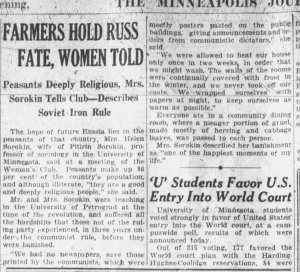
Helen Sorokin lecture – Minneapolis Journal 12-9-1925
“Exile Visons Key to Russ Salvation in Peasant Hands,” Minneapolis Star Tribune, December 29, 1925

Helen Sorokin lecture – Star Tribune 12-9-1925
— posted by Roger W. Smith
October 2024

‘Russia and US Always Friendly, Says Lectuter’ – Boston Globe 10-23-1942]
Posted here:
“Russia and U. S. Always Friendly, Says Lecturer”
The Boston Globe
October 23, 1942
*****************************************************
commentary by Yuri Doykov
Душа профессора Питирима Сорокина
Yuri Doykov, ‘The Soul of Professor Pitirim Sorokin’
‘Sorokin Stages Final Lecture Today’ – Valley State Sundial 3-17-1960 pg 1
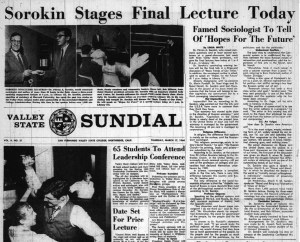

Yuri Doykov, October 17, 2024
Можно было еще добавить,что как раз в середине 30-х годов
многие русские друзья Питирима Александровича закончили
свою жизнь в подвалах сталинских тюрем (Элиава,Бессонов,
Витязев-Седенко, и так далее…)
One could also add that in the mid-30s many Russian friends of Pitirim Alexandrovich ended their lives in the basements of Stalin’s prisons (Eliava, Bessonov, Vityazev-Sedenko, and so on…)
— posted by Roger W. Smith
October 2024
Sorokin statement, actions re McCarthy censure – Harvard Crimson 12-2-1954
– posted by Roger W. Smith
October 2024
Sorokin to speak at Free French rally – Harvard Crimson 11-10-1941
Published in The Harvard Crimson
November 10, 1941
– posted by Roger W Smith
October 2024
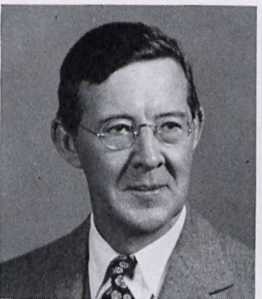
From the Harvard University 1947-48 yearbook.
– posted by Roger W. Smith
August 2024
President’s Report – U of Minnesota, 1924-1925
‘Research in Progress’ – U of Minnesota, 1924-1925
Sorokin taught at the University of Minnesota from 1924 to 1929. Posted here are:
President’s Report, University of Minnesota 1924-1925
Research in Progress, University of Minnesota. 1924-1925
detailing the writings and research activities of Sorokin, his collaborator Carle C. Zimmerman, and Sorokin’s wife, Helen Sorokin.
— posted by Roger W. Smith
August 2024
Lomonosova and Bulanova, ‘Bekhterev and Sororkin’
Lomonosova and Bulanova, ‘Bekhterev and Sorokin’ RUSSSIAN
Lomonosova and Bulanova, ‘Bekhterev and Sorokin’ ENGLISH
posted here:
М. В. Ломоносова, М. Б. Буланова, “В.М. БЕХТЕРЕВ И П.А. СОРОКИН: НАУЧНЫЙ СОЮЗ ВО ИМЯ СОЦИОЛОГИИ” (M. V. Lomonosova and M.B. Bulanova, “V.M. Bekhterev i P.A. Sorokin: Nauchnyy Soyuz vo Imya Sotsiologii’ [V. M. Bekhterev and P. A. Sorokin: Scientific Union in the Name of Sociology]”
The Russian original is posted as both as a PDF and Word document.
The English translation (Word document above) is by Roger W. Smith.
— posted by Roger W. Smith
July 2024
from Sorokin’s foreword to the 1967 edition of The Sociology of Revolution:
… one emendation needs to be made in my theory of revolution as outlined in this book. It stresses the “behavioristic” and biopsychological too much and does not sufficiently take into account the sociological. It overestimates the role of hereditary factors and unconditioned reflexes and underestimates somewhat the role of the acquired, sociocultural forces in the engenderment, development, suppression, and life course of revolutions; but the relationship between the unconditioned and acquired actions-reactions of individuals and groups in revolutions remains essentially the same as outlined in this study.
This volume does not analyse the course of revolutions beyond their second restraining phase. If it had, it would have shown that while some societies could not stand the fiery ordeal of a great revolution and have temporarily or forever lost their identity, unity, and independence, other societies have successfully overcome this danger and have established a new, post-revolutionary sociocultural order, system of values, and a nobler, better, more creative way of life. The Russian Revolution exemplifies this last course. The Soviet peoples have passed beyond the second phase of their revolution and are now building their post-revolutionary society, culture, and way of life. [italics added]
I agree with Sorokin’s comments on the overemphasis, in the first edition, on behaviorism. These sections of the book seem somewhat dated, tedious, and at times to have a pseudoscientific feel.
Re the comments about the Soviet peoples having “passed beyond the second phase of their revolution” and building a “post-revolutionary society, culture, and way of life”: this reflects the evolution of Sorokin’s .views about the Russian revolution and the USSR. See
Yuri Doykov, “Pochemu molchal Pitirim Sorokin?; Ot Lubyanki do Garvarda (1918-1930)” [Why was he silent?; Pitirim Sorokin? From the Lubyanka to Harvard (1918-1930)]
Foreword, ‘The Sociology of Revolution’
— posted by Roger W. Smith
August 2024
 Pitirim Alexandrovich Sorokin