re retirement of Sorokin – NY Times 3-24-1955
Above is a downloadable PDF file re the retirement of P. A. Sorokin from teaching duties at Harvard University.
“Sociologist at Harvard Quitting Teaching Post”
The New York Times
March 24, 1955
re retirement of Sorokin – NY Times 3-24-1955
Above is a downloadable PDF file re the retirement of P. A. Sorokin from teaching duties at Harvard University.
“Sociologist at Harvard Quitting Teaching Post”
The New York Times
March 24, 1955
Sergei P. Sorokin, ‘Life with Pitirim Sorokin; A Younger Son’s Perspective’
Sergei P. Sorokin, “Life With Pitirim Sorokin: A Younger Son’s Perspective”
– posted by Roger W. Smith
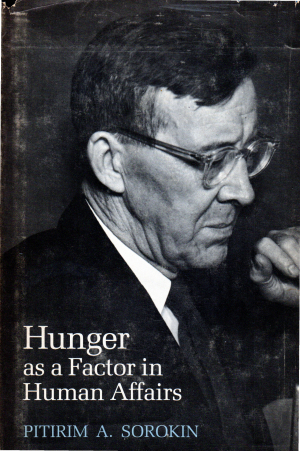
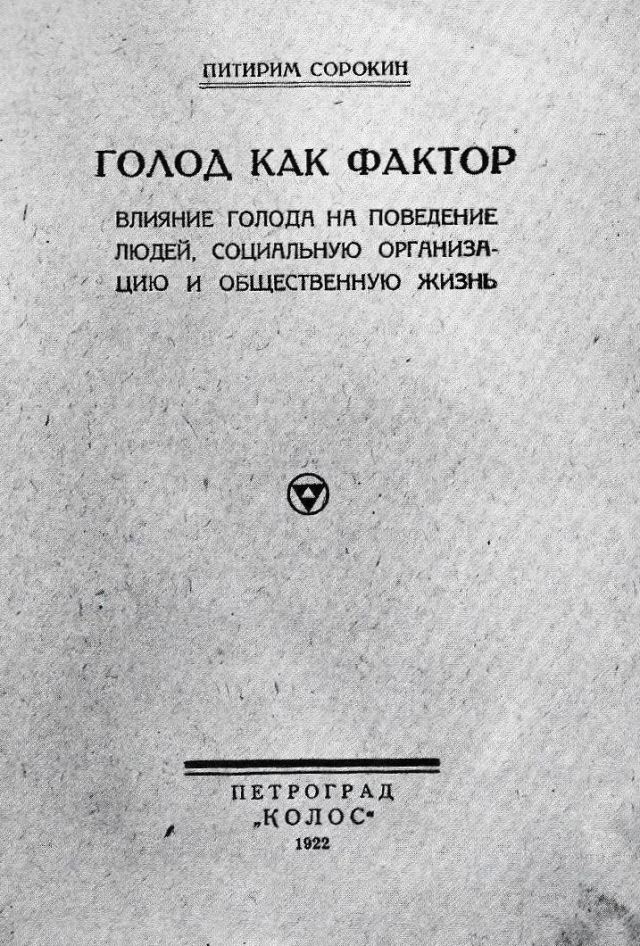
Pitirim A. Sorokin’s lifelong friend and fellow academic Carle C. Zimmerman, with whom Sorokin taught for many years, states in his Sorokin: The World’s Greatest Sociologist: His Life and Ideas on Social Time and Change (Saskatoon, Saskatchewan, Canada: University of Saskatchewan, 1968, pg. xiii-xiv), regarding Sorokin’s groundbreaking study голод как фактор (golod kak faktor; published in English as Hunger as a Factor in Human Affairs):
After the famine of 1921, … [Sorokin] embarked upon a study of the sociology of hunger and famine. The communist government had killed the landowners and tried to collectivize the peasants. As a result of this, agricultural production declined to disastrously low levels. A former grain exporting country could no longer feed itself. A drought in 1920 and 1921 resulted in wholesale starvation. Millions died of famine. Sorokin’s book about this was too much for the communists. His manuscript was destroyed and he accepted banishment September 23, 1922 to save his life.
This statement is misleading. The book was published in Petrograd in 1922. Soviet censors immediately destroyed it. It is easy to see why. Sorokin’s study was written in the midst of, and in response to, the Russian famine of 1921–22. It shows how the government in power can create such conditions.
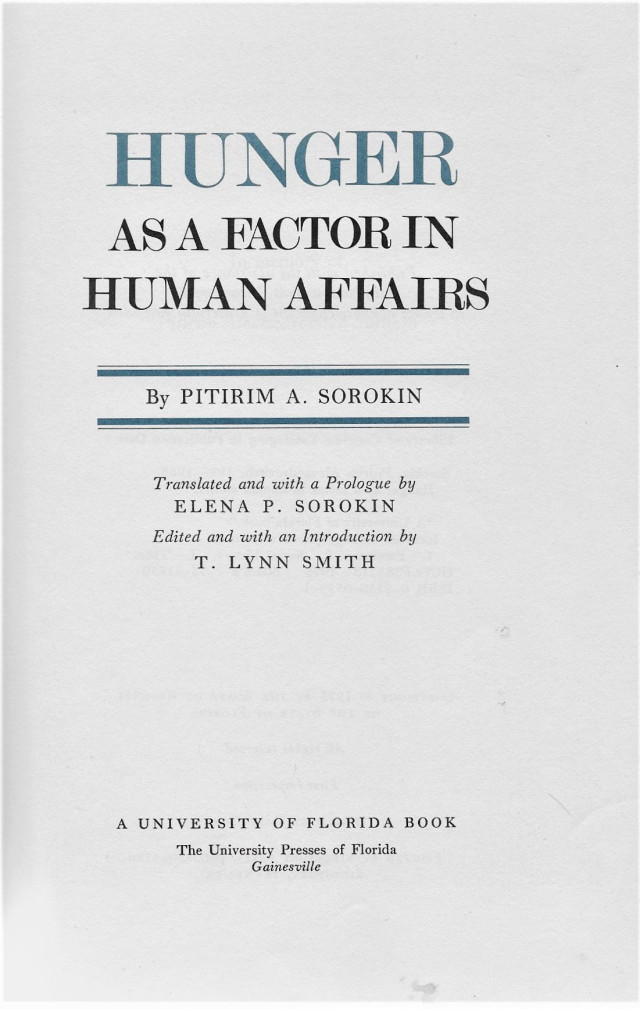
In the introduction to the English translation by Sorokin’s wife, Elena P. Sorokin, which was published in 1975 as Hunger as a Factor in Human Affairs, Elena Sorokin notes that “The censors … caught up with the book in its final stage of production and destroyed it. When Pitirim and I were banished from the USSR …, we smuggled out the proofs of the book.” It was published posthumously, as noted above, in a translation by Sorokin’s wife.
— Roger W. Smith
December 2017
****************************************************
‘Sees Peasant Role Redeeming Russia’ – NY Times 1-27-1924
“Sees Peasant Rule Redeeming Russia” (Pitirim A. Sorokin)
The New York Times
January 27, 1924
This very interesting article, quoting the views of the exiled Russian sociologist Pitirim A. Sorokin, is posted above as a downloadable PDF file.
— Roger W. Smith
December 2017
Robert Bierstedt review of ‘Hunger as a Factor’ – Social Forces
Carle C. Zimmerman review of ‘Hunger as a Factor’ – Social Science
In my post about the Russian-American sociologist Pitirim A. Sorokin, at
I stressed the originality and importance of Sorokin’s book Hunger as a Factor in Human Affairs, which I feel deserves to be better known.
Posted here are two reviews of the book which discuss its merits and the circumstances under which it was written and published:
review of Hunger as a Factor in Human Affairs by Robert Bierstedt, Social Forces, Vol. 55, No. 1 (Sep., 1976), pp. 195-196
review of Hunger as A Factor in Human Affairs by Carle C. Zimmerman, Social Science, Vol. 51, No. 2 (Spring 1976), Pp. 113-114
Robert Bierstedt (1913–1998) was a student of Sorokin’s who became a leading American sociologist. He headed the department of sociology at City College of New York and at New York University before becoming emeritus professor of sociology at the University of Virginia.
Carle C. Zimmerman (1897-1983) was a longtime colleague of Sorokin’s at the University of Minnesota and Harvard University.
— Roger W. Smith
December 2017
‘Colleagues of Revolution Meet in Boston’ (Kerensky, Sorokin) – Christian Sci Monitor
The Russian American sociologist and social philosopher Pitirim A. Sorokin (1889-1968), an ardent opponent of Communism, but an early supporter of the Russian Revolution, served during the Russian Revolution as secretary to Prime Minister Alexander Kerensky, who was a leader in the Russian Constituent Assembly.
After the October Revolution, Sorokin continued to fight communist leaders, and was arrested by the Bolshevik regime several times before he was eventually condemned to death. After six weeks in prison, he was set free and went back to teaching at the University of St. Petersburg. In 1918, he went on to become the founder of the sociology department at the University of St. Petersburg. In 1922, Sorokin was again arrested and this time exiled by the Soviet government. He emigrated in 1923 to the United States and was naturalized in 1930. Sorokin was professor of sociology at the University of Minnesota (1924–30) and at Harvard University (1930–59).
Attached here (above) as a downloadable PDF file is an article from the Christian Science Monitor of March 9, 1938. The article describes a meeting in Boston between Sorokin and Kerensky, who were reunited.
— Roger W. Smith
September 2017
Carle C. Zimmerman, ‘In Memoriam; Pitirim Alexanderovich Sorokin’
The memorial tribute to the Russian-American sociologist and social philosopher Pitirim A. Sorokin (1889-1968) which is posted above as a downloadable PDF file appeared in Carle C. Zimmerman, Sorokin: The World’s Greatest Sociologist: His Life and Ideas on Social Time and Change. The tribute provides a brief biography of Sorokin.
Carle C. Zimmerman was a lifelong friend and fellow academic of Sorokin.
Carle C. Zimmerman, “In Memoriam: Pitirim Aleksanderovich Sorokin,” in Sorokin: The World’s Greatest Sociologist: His Life and Ideas on Social Time and Change (Saskatoon, Saskatchewan, Canada: University of Saskatchewan, 1968), pg. xiii-xiv
— Roger W. Smith
August 2017
William T. Liu, ‘Sorokin in Review’ – The Review of Politics 1966
This seminal article on the Russian American sociologist and social philosopher Pitirim A. Sorokin appeared in The Review of Politics in January 1966. Ostensibly a review of Sorokin’s autobiography, A Long Journey, which had just been published, the article is actually an assessment of Sorokin’s life, career, and oeuvre. It addresses controversies going on at the time which involved a defense of Sorokin being undertaken by renowned sociologists, and in which there was controversy over how theoretical as opposed to empirical sociology should be.
The article is posted above as downloadable PDF file.
William T. Liu, “Sorokin in Review,” The Review of Politics, 28:1 (January 1966), pp. 99-105.
— Roger W. Smith
September 2017
‘Winchester garden aglow with azaleas’ – Boston Globe
Pitirim A. Sorokin residence, 8 Cliff St., Winchester, MA
Photographs by Roger W. Smith.
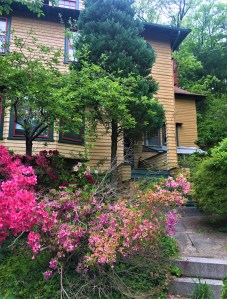


On May 24, 2017, I traveled by car to Winchester, Massachusetts, where the world famous Russian émigré sociologist and social philosopher Pitirim A. Sorokin, one of my heroes, lived.
Sorokin, his wife Elena P. Sorokin, and their two sons resided at 8 Cliff Street in Winchester. (Sorokin died in 1968. One of his sons still occupies the same residence.) I was interested not only to see the residence of a world renowned scholar and writer, but also to see the house because it was famous for its grounds: a garden developed and maintained by Sorokin himself, for which he had won awards from horticultural societies and of which he was proud.
I drove up the block, which was on a steep ascent, using GPS to guide me. The GPS system advised me that I had arrived at my destination, 8 Cliff Street, on my left. I saw 6 Cliff Street, but where was number 8? Number 8 was shrouded and hidden by a profusion of flowering bushes. It reminded me of the Forest of Thorns in “Sleeping Beauty.”
— posted by Roger W. Smith
September 2017
‘Sorokin Softens in Hatred of Reds’ – Chi Tribune 4-3-1949
Posted here (above) as a downloadable PDF file is an article based on an extremely informative and revealing interview — the article is notable for its accuracy — with Russian American sociologist and social philosopher Pitirim A. Sorokin (1889-1968).
“Professor Softens in His Hatred of Reds,” by Eugene Griffin, Chicago Daily Tribune, April 3, 1949
The Chicago Daily Tribune was a conservative newspaper with an anti-Communist slant.
— Roger W. Smith
September 2017
 Pitirim Alexandrovich Sorokin