Faculty Profile
NO WRITER ATTRIBUTED
The Harvard Crimson
April 22, 1941
“The biggest noise in an empty barrel for the year,” said Clifton Fadiman in the New Yorker. “He is to me like God,” wrote an awestruck Freshman in the Confidential Guide poll last spring. “The world’s foremost sociologist,” was the opinion of a professor in a midwestern university. In panning Sorokin’s book on “Social and Cultural Dynamics,” Fadiman referred to Harvard’s Department of Sociology as a “White Russian WPA.”* But Professor Sorokin, who is head of that WPA, began his career by being just as red as the rest of his intellectual, revolutionary friends. Back in 1916 in Petrograd, as a young lecturer, his ideas were well tinged with Utopian visions of a socialistic Russia. But his part in the “great experiment” was that played by so many moderates in so many revolutions, only with a happier ending. As he fed the Russian bear, it turned around and bit him. “In a revolution, power lies in the street for any one to pick up,” he wrote in one of his innumerable books. He stepped into the street just long enough to pick up a job as Secretary to Prime Minister Kerensky in the fall of 1917, but that success was so short-lived that soon he had to grow a beard to escape detection by the Bolsheviks who had seized power and were after him. As the blue blood began to run, and the red as well, Sorokin became sickened by the cruelty and irresponsibility of the anarchists and turned counter-revolutionary. He spent fifty days in the Petropavlovskaia Fortress, another word for Bastille, for having “attempted to assassinate Lenin.” It turned out that what they thought was a pistol shot had only been a tire blowout, but he was kept in prison for good measure. Writing anti-government pamphlets and articles was not a healthy occupation in Russia in 1918, and soon Sorokin found himself sentenced to death. At the last minute he was saved by a combination of luck and the work of a friend who must have put in a good word with Lenin. Back in Petrograd teaching again, on precarious academic tenure, he found it impossible to indoctrinate the sons of the proletariat with the first principles of sociology. He contrived to get himself banished from Russia in 1923, and from then on the tempo of the Sorokin drama relaxed. A short term of lecturing in Prague, then on to America. Professor at the University of Minnesota until 1930, and at Harvard since then.
Professor Sorokin now lives in Winchester, with the Mystic Valley Reservation for a back yard, which gives him “all the advantages of an estate without any of the duties.” When he is not lecturing or writing or breakfasting with his friend Serge Koussevitsky, the professor likes to work in his garden behind the house, an interest perhaps inherited from his many Russian forebears. When they want more lengthy relaxation. Mother and Father and the two boys move to their camp in Canada where Father forgets his vertical and horizontal mobility long enough to be a compleat angler. He despairs of modern jazz, movies, radio, advertising, and has a high unconcern for the press. He is above all criticism, good or bad, from a world whose culture and civilization are degenerate. He has an enormous and un-selfconscious ego concerning the immortality of his works, but won’t budge form the assertion that none of the modern greats correspond in ability to those of the past. “When there are no fish, a crawfish is a fish,” he says. “I am a crawfish.” Yet he has doubled the size of Harvard’s Sociology Department, attracted a brilliant group of graduate students, and has probably written as many books in his field as any man in history. Although he scorns the “sensational, vulgar, misleading, and distorting press,” he manages to cull yearly as much publicity as the average Hollywood starlet.
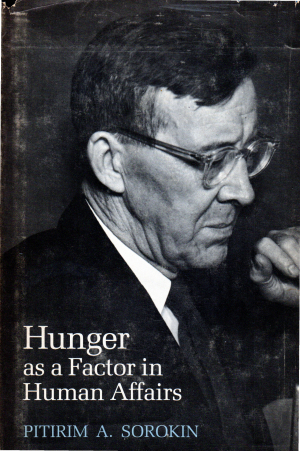
Personally, Professor Sorokin is as pleasant and charming an egoist as it is possible to find at Harvard, home of many successful men. His eyes, behind steel-rimmed glasses, glitter smilingly with every word he utters. Some people who take his courses groan that they can’t understand a word he says. A little judicious listening, coupled with the immunity gained after a few of his lectures, should fix that. Short, boyishly cut gray hair, a rapid and brusque manner, make him seem a tall little man. A conversation with Sorokin requires an effort to keep up with his wit, and when he gets serious, an effort to grasp what he is talking about. For him, the best art, literature, and music was produced before the nineteenth century. Enough of a cosmopolite to prefer Bach, Beethoven, and Mozart to Tchaikovsky and Rimsky Korsakov, smoke English instead of Russian cigarettes, keep cases of French wine in his cellar instead of scotch or vodka, and obtain American citizenship in 1930, he is nevertheless simple and quiet in taste, abhorring social life and all that it entails. However, the professor continues to sling his provoking social theories into the intellectual boxing ring, and although they get slammed around quite a bit there’s no reason why he shouldn’t come out a winner in the end.
* Porter Sargent , a former Harvard professor, publisher, and commentator and critic of higher education. was quoted in an article in Time (May 30, 1938) as follows: “The [Harvard] sociology department is the White Russian WPA.” This quote was misattributed by the Crimson writer to Clifton Fadiman.
— posted by Roger W. Smith
April 2022
‘Plain Talker’ (Porter Sargent on Sorokin) – Time 5-30-1938




 Pitirim Alexandrovich Sorokin